


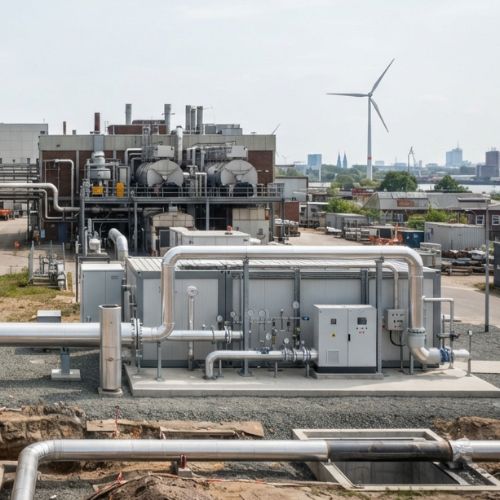
Adhesive tape manufacturer tesa has signed an agreement with EWE HYDROGEN GmbH to secure around 500 tonnes of renewable hydrogen annually for its Hamburg production site from 2028, linking the plant’s industrial decarbonisation plans with EWE’s planned large-scale hydrogen production in Emden.
Under the agreement, EWE will supply hydrogen produced at its 320 MW hydrogen production facility in Emden, which is scheduled to begin operations at the end of 2027. The hydrogen will be transported to Hamburg through the emerging German hydrogen core network and connected to the tesa site via the Hamburg Hydrogen Industrial Network (HH-WIN).
tesa expects the switch to hydrogen for steam generation to avoid approximately 6,000 metric tonnes of CO₂e emissions annually. The company plans to use the fuel where process heat requirements cannot be fully electrified.
The supply agreement was signed by EWE CEO Stefan Dohler and tesa CEO Dr Kourosh Bahrami and covers the full planned annual hydrogen requirement of the Hamburg plant.
Hydrogen to replace fossil fuels in steam generation
The Hamburg facility is tesa’s largest production site and has the highest energy consumption and emissions within its manufacturing network. Its production processes require substantial amounts of process heat and steam, including for drying operations and solvent recovery.
tesa’s decarbonisation strategy combines electrification, thermal energy storage, hydrogen and digital energy management rather than relying on a single technology.
Hydrogen is intended to replace fossil fuels in applications where direct electrification is not considered sufficient for the required process-heat demand.
The company is installing two hydrogen-ready dual-fuel steam boilers at the Hamburg site. The first boiler has already been installed and connected, while the wider transformation includes the infrastructure required to receive hydrogen through HH-WIN.
tesa also uses its “Energy Intelligence” platform to combine information from energy infrastructure, production and energy markets. The company says this allows energy consumption to be optimised according to operating conditions and market signals.
Hamburg hydrogen connection
The tesa plant is being connected to HH-WIN, Hamburg’s hydrogen industrial network operated by Hamburger Energienetze.
The city confirmed in March 2026 that tesa had received a €950,000 funding commitment for the hydrogen conversion and network connection. The connection is planned to be completed by 2027, enabling the plant to access hydrogen through Hamburg’s developing hydrogen infrastructure.
HH-WIN is being developed as part of Hamburg’s wider hydrogen infrastructure and is intended to connect industrial consumers with hydrogen production, import infrastructure and the national hydrogen core network. The first approximately 40 kilometres of the network are planned for operation from 2027, with further expansion planned thereafter.
For tesa, the network connection is therefore a critical component of the supply agreement: the hydrogen contract depends not only on production capacity in Emden, but also on the availability of the pipeline infrastructure linking hydrogen production with industrial demand.
EWE’s 320 MW Emden electrolyser anchors supply
The hydrogen allocated to tesa is planned to come from EWE’s 320 MW hydrogen production facility in Emden, part of the company’s Clean Hydrogen Coastline project.
EWE officially began construction of the Emden facility in November 2025. The project is designed to produce renewable hydrogen through electrolysis and supply industrial customers from the end of 2027.
EWE has also awarded major equipment and construction contracts for the project. Siemens Energy was selected in 2024 to supply a 280 MW electrolyser system, while EWE subsequently awarded contracts covering compressors, construction and balance-of-plant installation.
The project forms part of the wider Clean Hydrogen Coastline programme, which integrates hydrogen production, storage and transport infrastructure in north-western Germany.
EWE is also developing the H₂Coastlink 1 pipeline between Emden and Leer. The approximately 24-kilometre pipeline is intended to connect the 320 MW Emden electrolyser with the German hydrogen core network and is scheduled for commissioning in autumn 2027.
This infrastructure is important to the tesa agreement because the company’s hydrogen will ultimately move from the production site in Emden into the wider hydrogen network before reaching industrial users in Hamburg.
The hydrogen produced by EWE is intended to comply with European requirements for renewable hydrogen under the Renewable Fuels of Non-Biological Origin (RFNBO) framework.
Hydrogen forms part of a wider industrial decarbonisation strategy
The tesa project illustrates the role hydrogen can play alongside electrification in industrial heat applications.
Rather than replacing the plant’s entire energy system with hydrogen, tesa is combining several technologies. Electrification and thermal storage are intended to address process-heat requirements that can be converted to electricity, while hydrogen is being reserved for applications where direct electrification is less suitable.
This approach is increasingly relevant for industrial facilities where steam and high-temperature heat are integral to production.
tesa has set a target of making its production climate-neutral by 2030 and says it plans to invest approximately €300 million in the transformation of its business by 2030. The company reports that its Scope 1 and Scope 2 emissions have already fallen by 50% from its 2018 baseline, while 95% of its global electricity demand is covered by renewable electricity.
The Hamburg project is consequently one component of a broader manufacturing transformation rather than an isolated hydrogen initiative.
Supply contracts begin to connect Germany’s hydrogen infrastructure with industrial demand
The agreement is also significant for the development of Germany’s emerging hydrogen market because it creates a direct link between a large-scale production project and an identified industrial consumer.
EWE described the tesa agreement as its second industrial green-hydrogen supply contract, following its agreement with Salzgitter AG. The company has argued that long-term customer commitments are needed to support the development of a commercially viable hydrogen market.
For tesa, the arrangement provides greater visibility over the future energy supply of one of its most energy-intensive production sites. For EWE, securing industrial customers provides an additional demand signal for the Emden electrolyser and associated transport infrastructure.
The project’s implementation will nevertheless depend on the coordinated delivery of several elements — including the Emden production facility, hydrogen transport infrastructure, the HH-WIN connection and tesa’s own conversion of its steam-generation systems.
Bioenergy Business Analysis
The tesa-EWE agreement demonstrates a different dimension of Germany’s industrial hydrogen build-out: the development of demand alongside production and infrastructure.
A 500-tonne annual contract is modest compared with the output potential of a 320 MW electrolyser, but its importance lies in connecting a defined industrial application to a planned hydrogen supply chain. EWE’s Emden facility, the hydrogen core network and Hamburg’s HH-WIN system are being developed as interconnected infrastructure, while tesa is investing in equipment capable of switching from fossil fuels to hydrogen.
The project also highlights where hydrogen is likely to compete with electrification. tesa is not positioning hydrogen as a universal replacement for electricity; instead, the company plans to use electrification, thermal storage and digital energy management wherever possible and hydrogen for remaining steam and process-heat requirements. That technology mix could become an important model for industrial sites where complete electrification is technically or economically difficult.