


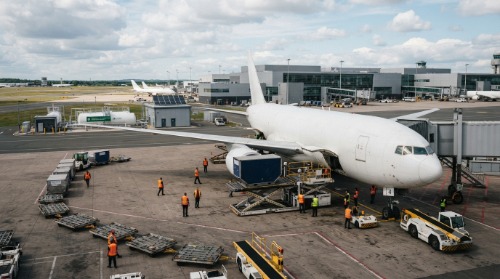
Danish design company Stilling is using DHL Express’ GoGreen Plus service, backed by Neste’s sustainable aviation fuel (SAF), to address greenhouse gas emissions associated with its international freight operations.
The collaboration brings together Stilling, logistics provider DHL and renewable-fuels producer Neste to tackle a challenge common to companies with time-sensitive global supply chains: reducing Scope 3 transport emissions without changing delivery requirements.
Stilling, a family-owned Danish company specialising in bespoke drapery hardware, operates under a business strategy it calls “Purposeful Growth” and uses a triple-bottom-line approach that considers its impact on people, communities and the environment.
For the company, however, reducing emissions from global distribution is more difficult than controlling its own manufacturing operations.
“Our product is usually part of a larger project, which makes on-time delivery absolutely critical,” said Thomas Trads Hansen, CEO of Stilling, according to Neste. “It’s a balancing act” between maintaining delivery performance and lowering greenhouse gas emissions.
Scope 3 presents a challenge for time-critical logistics
Stilling identifies Scope 3 emissions as a particular challenge because they arise across activities involving external partners and suppliers.
Transport is one area where companies can have limited direct operational control. For Stilling, international deliveries can involve air freight while maintaining strict delivery schedules for customers and larger projects.
The company has therefore sought to reduce the climate impact of its logistics through its supply-chain partners rather than relying solely on changes within its own manufacturing operations.
Neste SAF supports lower-emission air freight
Neste supplies the SAF used within the logistics ecosystem supporting DHL’s GoGreen Plus service.
Neste MY Sustainable Aviation Fuel is produced from renewable waste and residue feedstocks, including used cooking oil and animal-fat waste. The fuel is designed as a drop-in alternative to conventional aviation fuel and can be used with existing aircraft engines and airport fuelling infrastructure when blended in accordance with applicable requirements.
Neste’s current SAF production capability is 1.5 million tonnes per year, with the company expecting this to increase to 2.2 million tonnes per year in 2027 following the planned expansion of its Rotterdam refinery.
Carl Nyberg, Senior Vice President Commercial, Renewable Products at Neste, said the company’s role is to provide renewable fuels that can be integrated into existing transport systems without requiring changes to aircraft or fuelling infrastructure.
For companies seeking reductions in logistics-related emissions, that compatibility allows SAF to be introduced without replacing existing aircraft or redesigning freight networks.
DHL uses book-and-claim to extend SAF access
A central element of the arrangement is DHL Express GoGreen Plus, which uses a book-and-claim mechanism to allocate verified emissions reductions associated with SAF to participating shipments.
Physical SAF availability is not uniform across global aviation networks. Under a book-and-claim system, the environmental attributes associated with SAF can be allocated to a customer’s shipment even when the specific aircraft carrying that shipment does not physically use SAF.
DHL explains that its GoGreen Plus model allows the environmental benefit of sustainable fuel to be decoupled from the location where the fuel is physically consumed. The company receives documentation associated with sustainable fuel volumes and allocates the resulting emissions reductions to participating customers.
Andreas Mündel, Senior Vice President, Strategy & Operations Programs at DHL Group, said the company calculates the fuel requirement associated with a shipment and ensures that a corresponding quantity of SAF is used somewhere within its network.
The approach allows DHL to integrate SAF into existing freight services while providing customers with a mechanism to account for the associated Scope 3 emissions reduction.
DHL’s methodology also includes external verification and documentation for emissions reductions under its GoGreen Plus offering.
Stilling selects GoGreen Plus for international shipments
Stilling chose DHL Express GoGreen Plus as a mechanism for incorporating renewable aviation fuel into its international logistics strategy.
The company said the service provides a way to work towards reducing transport-related emissions while maintaining its existing delivery requirements.
For Stilling, this is particularly relevant because its products are often incorporated into larger construction, interior or design projects where delivery schedules can be commercially important.
The company’s approach also illustrates the distinction between reducing emissions within a company’s own operations and addressing emissions generated elsewhere in its value chain.
SAF availability remains a scaling constraint
The Stilling-DHL-Neste arrangement also highlights one of the main challenges facing SAF adoption: scaling supply sufficiently to reduce costs and expand access.
Markus Otto, Executive Vice President Global Aviation at DHL Express, said greater SAF availability is needed to bring down unit costs and make lower-emission logistics solutions more broadly accessible.
DHL has also expressed support for regulatory measures intended to stimulate SAF production and consumption, including the ReFuelEU Aviation framework.
Neste states that neat, or unblended, Neste MY SAF can meet the ReFuelEU Aviation sustainability criteria, including the requirement for at least 65% lifecycle greenhouse gas savings compared with fossil fuel, subject to the applicable sustainability requirements. The fuel remains certified for commercial aviation use and can currently be blended up to 50% with conventional jet fuel.
The lifecycle figure should not be interpreted as a 65% reduction in the carbon dioxide emitted during a flight. SAF and fossil jet fuel release broadly similar amounts of CO₂ during combustion; the principal climate benefit described by Neste relates to the fuel’s lifecycle emissions, including feedstock production, processing, transport and fuel use.
From fuel production to corporate Scope 3 action
The collaboration illustrates how renewable-fuel producers, logistics companies and corporate customers can connect SAF supply with demand for lower-emission freight services.
Neste provides the renewable fuel, DHL integrates SAF into its logistics network and book-and-claim offering, while Stilling uses the service to address emissions associated with its international transport activity.
The model is particularly relevant for businesses that cannot directly control the fuel used on individual aircraft or freight routes but still need mechanisms to address value-chain emissions.
DHL and Neste have previously worked on systems designed to improve the traceability of sustainability benefits associated with SAF transactions. A pilot involving Neste, DHL Group and the International Sustainability and Carbon Certification (ISCC) system was designed to track environmental attributes through the value chain and reduce the risk of double counting.
The Stilling case therefore demonstrates the commercial application of a broader SAF ecosystem in which physical fuel deployment and corporate emissions accounting are connected through verified allocation mechanisms.