


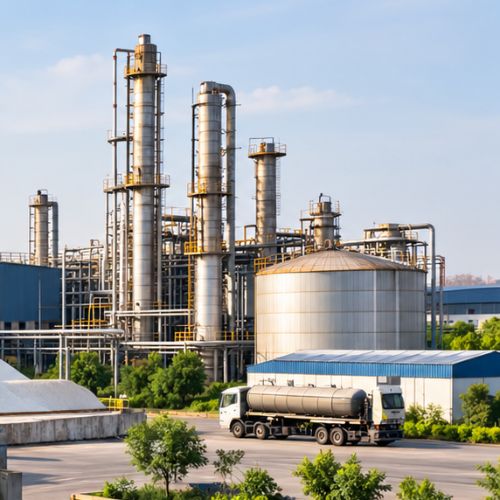
Indonesia’s state asset management agency Danantara plans to invest in ethanol production infrastructure and sugarcane plantations over the next three years as the country moves towards a larger domestic bioethanol industry and a phased E20 gasoline blending programme.
Danantara aims to complete the investment cycle by 2029, according to its COO Dony Oskaria. The planned investment will include an ethanol plant and sugarcane plantations, with development expected to proceed in stages.
The investment comes as Indonesia seeks to replicate the rapid expansion of its biodiesel programme with ethanol, following the nationwide rollout of the B50 biodiesel mandate in July 2026. The government is pursuing higher biofuel blending as part of a broader strategy to reduce dependence on imported fossil fuels and strengthen domestic energy and agricultural supply chains.
Danantara to develop ethanol plant and sugarcane supply
Oskaria said Danantara’s planned ethanol investment would include both processing infrastructure and sugarcane plantations.
The approach reflects a key constraint facing Indonesia’s ethanol ambitions: increasing production capacity alone will not guarantee sufficient feedstock. Expansion of sugarcane cultivation is therefore being considered alongside new ethanol-processing facilities.
The Indonesian government has separately instructed authorities to prepare approximately 2 million hectares of land for sugarcane cultivation to support the E20 programme. The land is expected to be developed across Java, Sumatra, Kalimantan and Papua. Danantara has been tasked with developing the industrial side of the programme, including ethanol conversion facilities.
The government has identified sugarcane as its preferred feedstock for the initial large-scale E20 programme, although earlier policy discussions have also considered agricultural commodities such as cassava and corn.
E20 programme creates large ethanol demand
Indonesia’s planned expansion of ethanol infrastructure is being driven by the scale of the country’s gasoline market.
The Ministry of Energy and Mineral Resources has estimated annual gasoline consumption at approximately 40 million kilolitres. At a 20% ethanol blend, the government estimates that around 4 million kilolitres of ethanol per year would be required.
The government has said the ethanol required for E20 is intended to be produced domestically. In September, Coordinating Minister for Food Affairs Zulkifli Hasan said the administration was preparing for domestic E20 production within two years and that Danantara would develop the required processing industry.
Indonesia’s existing ethanol market remains substantially smaller than the scale required for E20, making new production plants, feedstock development and downstream blending infrastructure necessary before the higher blend can be implemented nationally.
Indonesia has already begun its ethanol blending programme
Indonesia’s E20 plans build on an existing, smaller ethanol-blending programme.
The country began implementing E5, a gasoline blend containing 5% ethanol, in July 2026 in six provinces: East Java, Jakarta, West Java, Banten, Central Java and Yogyakarta. The government has subsequently accelerated its ambitions for higher ethanol blending.
In August, the government said it was targeting E20 by 2029. By September, however, officials had outlined an accelerated approach aimed at achieving E20 production within two years.
The changing timeline places additional pressure on the development of ethanol production capacity, sugarcane cultivation and fuel-distribution infrastructure.
Feedstock availability remains a key challenge
The expansion of sugarcane-based ethanol faces a different starting point from Indonesia’s biodiesel industry.
Indonesia has an established palm oil industry capable of supplying feedstock for its large-scale biodiesel programme. Ethanol, by contrast, requires the expansion of sugarcane production and processing capacity at a time when the country’s sugar industry remains dependent on imports to meet domestic requirements.
Danantara’s plan to invest in both plantations and ethanol infrastructure reflects this upstream constraint.
The government’s 2-million-hectare sugarcane expansion plan is intended to address the feedstock side of the equation, while Danantara’s investment is expected to build part of the processing capacity required to convert that feedstock into fuel ethanol.
B50 provides model for Indonesia’s ethanol strategy
Indonesia’s ethanol programme is being developed against the backdrop of the country’s rapid biodiesel expansion.
The government launched its B50 mandate in July 2026, requiring a 50% palm-based biodiesel blend in diesel fuel. The programme was designed to reduce diesel imports, increase domestic palm oil consumption and strengthen energy self-sufficiency.
Danantara’s ethanol strategy appears to follow a similar policy logic: develop domestic agricultural feedstock, build processing infrastructure and progressively increase the share of renewable fuel in the domestic transport market.
However, the feedstock systems are fundamentally different. Indonesia’s biodiesel programme is supported by a large and established palm oil industry, whereas the ethanol programme requires substantial additional investment in sugarcane cultivation and sugar-processing infrastructure.
Ethanol infrastructure will require coordinated investment
The scale of the E20 ambition means that investment will extend beyond ethanol plants.
Indonesia will require sufficient sugarcane production, sugar mills and ethanol conversion capacity, together with storage, transport, blending and fuel-distribution infrastructure.
Pertamina Patra Niaga, the commercial and trading arm of state-owned energy company Pertamina, has already been preparing terminals, storage tanks and blending systems for bioethanol. The company has also sought an excise exemption for fuel-grade ethanol imports while domestic production capacity is being developed.
The infrastructure build-out will therefore involve multiple parts of the energy and agricultural value chain rather than standalone ethanol facilities.
The government has also indicated that it expects the state to act as a primary offtaker for domestically produced ethanol, potentially providing greater certainty for producers and upstream agricultural investors.
Danantara investment timeline extends to 2029
Danantara’s planned three-year investment programme is intended to support the country’s transition towards greater domestic ethanol production.
Oskaria said the agency would develop the sector gradually, with the full investment cycle targeted for completion by 2029. The plans include an ethanol factory and sugarcane plantations, although specific investment amounts, plant locations, production capacities and individual project timelines have not yet been disclosed.
The absence of detailed project specifications means the investment should currently be viewed as part of Indonesia’s broader ethanol-development programme rather than as a fully defined project pipeline.
For Danantara, the next stage will be translating the national E20 target into bankable projects with secured feedstock, suitable land, processing technology and downstream market access.