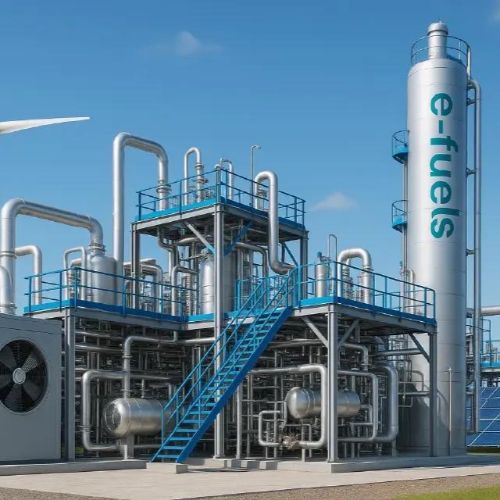
Irish renewable energy developer Galetech has signed a technology partnership with Dutch carbon-capture company Skytree to develop synthetic fuels, including sustainable aviation fuel (SAF), using carbon dioxide captured directly from the atmosphere.
The agreement with Skytree and Mwahera Green Hydrogen targets direct air capture (DAC) at the planned Mwangea e-fuels project in Kenya. The captured carbon dioxide is intended to serve as a feedstock for e-fuels, which can provide alternatives to conventional petroleum-derived fuels in aviation, shipping and heavy goods transport.
The agreement advances Galetech’s plans to establish an e-fuels business alongside its existing wind, solar and electricity storage activities. The company has been developing its synthetic fuels strategy since last year, with a pilot research and production facility planned at its Edrans wind farm in Cootehill, County Cavan, Ireland.
Galetech integrates direct air capture into synthetic fuel plans
Under the partnership, the companies plan to use Skytree’s systems to extract carbon dioxide from ambient air. The captured carbon can then be used as a carbon feedstock in the production of synthetic fuels, provided the process is supplied with the required hydrogen and energy inputs.
E-fuels are produced using electricity, hydrogen and carbon-containing feedstocks. In pathways that combine green hydrogen with captured carbon dioxide, the resulting synthetic hydrocarbons can be processed into fuels designed for applications such as aviation and maritime transport.
These fuels are attracting interest because sectors such as long-haul aviation and shipping face technical and operational challenges in transitioning directly to battery-electric systems. Synthetic fuels may offer compatibility with existing engines and fuel infrastructure, subject to the fuel’s specification and certification.
Skytree originally developed its carbon-capture technology for the European Space Agency, according to the source report. The partnership is intended to connect atmospheric carbon capture with renewable energy generation and downstream synthetic fuel production.
Pilot e-fuels facility planned in County Cavan
Separately, Galetech announced plans last year to develop a pilot e-fuels research and production facility at its Edrans wind farm in Cootehill, County Cavan. The proposed facility is intended to produce fully renewable synthetic alternatives to petrol, diesel and kerosene.
The company has also established a dedicated e-fuels brand and recruited staff to develop the business. The Kenyan Skytree agreement concerns a separate project; the company’s Ireland pilot is part of its broader e-fuels strategy.
Galetech’s director of e-fuels, Michael Bermingham, described the partnership as a milestone for the business, saying the technology would help the company begin production cost-effectively.
Bermingham also identified airlines, shipping operators and transport companies as potential customers seeking to reduce their reliance on fossil fuels.
Skytree positions atmospheric carbon as a fuel feedstock
Skytree’s direct air capture systems are designed to extract carbon dioxide from ambient air for use in industrial applications. Under the Galetech partnership, the technology is expected to provide carbon feedstock for synthetic fuel development at locations where renewable energy is available.
Peter van Hooft, Skytree’s vice-president of project development, said capturing atmospheric carbon dioxide near clean energy generation facilities could help establish a more predictable supply of carbon feedstock for synthetic fuels.
The approach could link three elements of the e-fuels value chain: renewable electricity, carbon capture and fuel synthesis. Nevertheless, capturing carbon dioxide is only one stage of production. Producing hydrocarbon fuels also requires hydrogen, suitable conversion processes and additional energy for synthesis and refining.
The overall economics will depend on the efficiency of the capture equipment, the availability and cost of renewable electricity and hydrogen, and the capital and operating costs of the fuel-production plant.
EU SAF requirements create a potential aviation market
Galetech sees aviation as a key potential market for its e-fuels business as the European Union increases requirements for sustainable aviation fuel use.
Under the EU’s ReFuelEU Aviation framework, suppliers must progressively increase the share of SAF supplied at covered EU airports. The framework also includes a dedicated requirement for synthetic aviation fuels, creating a policy-driven market for qualifying e-fuels.
Synthetic aviation fuel produced from renewable hydrogen and eligible carbon sources could contribute to this market, provided it meets the applicable sustainability, emissions-accounting and fuel-certification requirements.
For Galetech, the opportunity is to combine renewable power development with carbon capture and synthetic fuel production. Whether the model can be scaled commercially will depend on project execution, fuel certification, production costs and the ability to secure long-term customers.
The Skytree agreement marks progress towards Galetech’s stated ambitions, but the partnership itself should not be interpreted as evidence that commercial SAF production has begun.
Bioenergy Business Analysis
Galetech’s agreement with Skytree highlights a developing route towards lower-carbon aviation fuels. Unlike biofuel pathways based on used cooking oil, animal fats or agricultural residues, this approach relies on carbon captured from the air and hydrogen produced using low-carbon energy.
The central commercial challenge is the cost of producing e-fuels at scale. Direct air capture requires energy to extract and concentrate carbon dioxide from the atmosphere, where its concentration is relatively low. Fuel synthesis then requires additional energy and processing. Access to renewable electricity alone will not guarantee competitive production costs; hydrogen supply, plant utilisation, capital expenditure and conversion efficiency will also matter.
The partnership’s potential value lies in integrating renewable power with fuel production. Galetech’s existing wind and solar activities could provide a foundation for developing this integrated model. However, the extent to which renewable electricity can be supplied economically and consistently to a fuel plant will depend on project design, power availability and the operating requirements of the capture and synthesis equipment.
For the wider energy-transition industry, the agreement illustrates how renewable energy developers are exploring opportunities beyond electricity generation. Its significance will ultimately depend on whether the integrated system can deliver certified synthetic fuels with demonstrable emissions benefits at commercially sustainable costs.