


Metacon’s wholly owned Greek subsidiary, Metacon SA, has secured €188,018 in European Union funding for its participation in the PUREHY2+ project, which aims to develop an integrated system for producing high-purity hydrogen from biogas while separating carbon dioxide for potential capture.
The project has a total budget of €1.63 million and will run for 36 months. Metacon’s allocated project budget is €235,022, of which €188,018 will be covered by public funding, representing an 80% funding rate.
PUREHY2+ aims to enable existing biogas producers to add hydrogen production to their operations, creating another potential use for renewable gas derived from organic waste. The proposed system will target hydrogen purity above 99.97% and separate carbon dioxide during processing.
PUREHY2+ targets high-purity hydrogen from biogas
Biogas is produced from organic waste at facilities across Europe and is commonly used for electricity and heat generation or upgraded to biomethane. PUREHY2+ seeks to develop technology that would allow these facilities to produce high-purity hydrogen as an additional product.
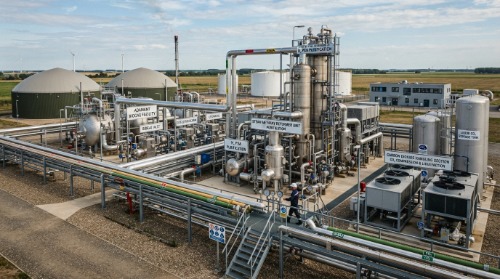
The project will focus on an integrated system combining biogas processing, hydrogen production and gas purification, with carbon dioxide separated for capture on site.
The approach could create another pathway for using existing biogas infrastructure to supply renewable hydrogen. Rather than relying exclusively on newly developed, electricity-intensive hydrogen production capacity, the system is intended to build on the renewable feedstock and production assets already available at biogas plants.
The project’s hydrogen purity target is above 99.97%. The announcement does not specify the planned production capacity or identify facilities where the system will be deployed commercially.
Metacon receives 80% public funding for its project allocation
Metacon SA has a project budget of €235,022 under PUREHY2+. The EU grant covers €188,018, leaving €47,004 of the allocated budget outside the stated public funding.
The project-wide budget is €1,626,622, with implementation planned over 36 months. The announcement does not provide a specific completion date.
For Metacon, the project supports further development of its proprietary reforming technology, gas purification systems and system integration capabilities. The company is seeking to advance these technologies for applications within existing biogas infrastructure.
Project builds on earlier PUREHY research
PUREHY2+ builds on the completed PUREHY project, during which the consortium developed and evaluated what Metacon describes as Greece’s first semi-pilot unit for on-site hydrogen production and purification from biogas.
The follow-on project will seek to advance that work towards a more integrated and adaptable system for biogas producers.
The progression from semi-pilot development to a more integrated solution is intended to address the technical requirements of producing high-purity hydrogen from biogas while separating carbon dioxide within the same process.
However, PUREHY2+ remains a development project. The announcement does not confirm commercial-scale deployment, operating performance or the cost of hydrogen produced through the proposed system.
Metacon identifies new applications for existing biogas assets
Metacon President and CEO Christer Wikner said the project could help extend the use of existing renewable feedstock and infrastructure beyond conventional biogas applications.
“Biogas plants already have access to valuable renewable feedstock and established production infrastructure. We see great potential in how these assets can also be used to produce high-purity green hydrogen and capture green carbon dioxide on site,” Wikner said.
He added that the project would allow Metacon to advance its technology towards a system solution for existing biogas producers and the wider hydrogen market.
The potential commercial application will depend on the project’s technical results, the economics of hydrogen production and the ability to integrate the system into operating biogas facilities.
Bioenergy Business Analysis
PUREHY2+ explores a potential link between established biogas infrastructure and the market for high-purity renewable hydrogen. If the system can be demonstrated technically and commercially, biogas producers could gain an additional product stream without necessarily having to develop an entirely new feedstock supply chain. The project also integrates carbon dioxide separation, which could create opportunities for further use or storage of the separated carbon, depending on its quality, handling requirements and available infrastructure.
The distinction between biogas-derived hydrogen and hydrogen produced through water electrolysis is important. The proposed system uses biogas as its feedstock, with reforming and purification technologies forming part of Metacon’s development work. Its overall greenhouse gas performance will depend on feedstock sourcing, process energy, methane leakage, carbon dioxide management and other lifecycle factors. The project’s purity target and funding award do not, on their own, establish its emissions performance or commercial viability.