

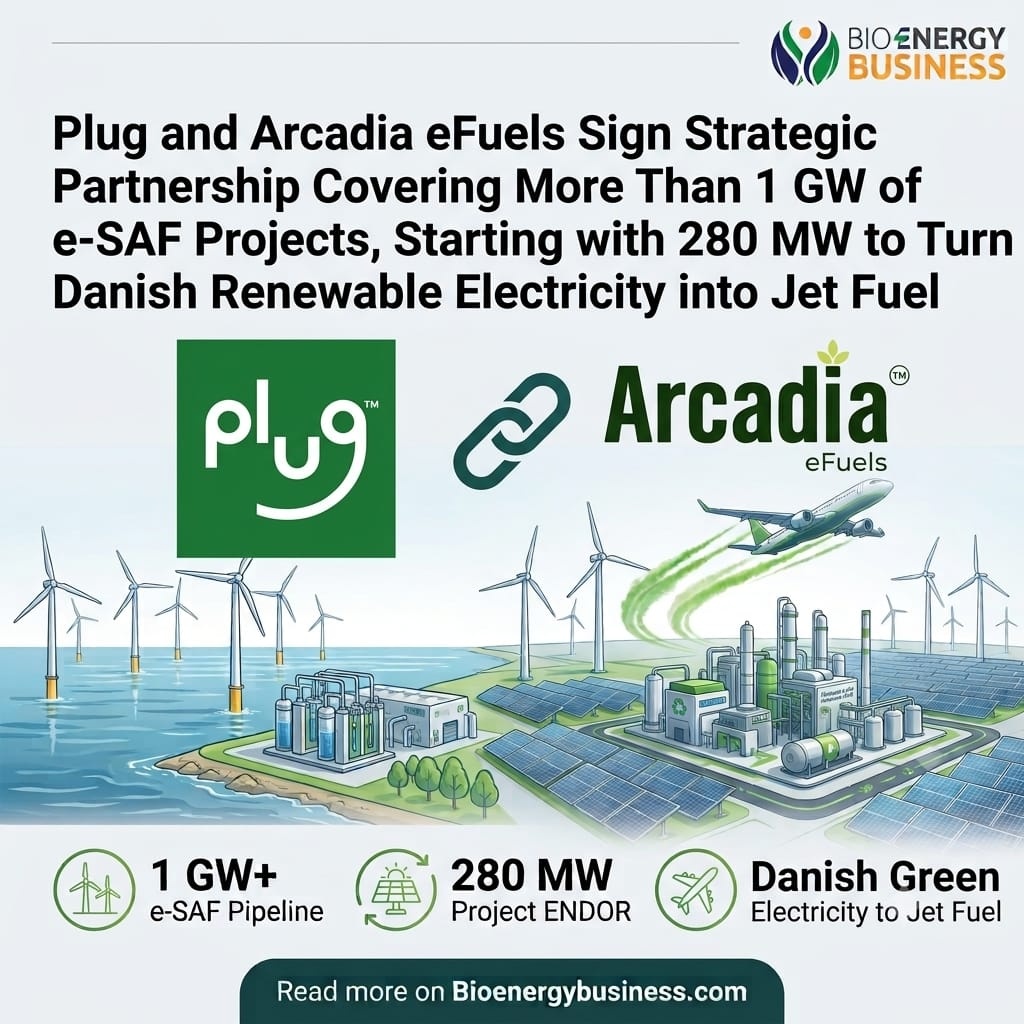
Plug Power has signed a 280 MW electrolyzer supply agreement with Arcadia eFuels for the e-SAF Project ENDOR in Denmark, alongside a strategic cooperation covering more than 1 GW of potential electrolyzer capacity across future e-SAF projects in Europe and the Americas.
The agreement places Plug’s GenEco electrolyzers at the centre of Arcadia’s planned power-to-liquid sustainable aviation fuel (e-SAF) facility at the Port of Vordingborg on Denmark’s south coast.
Under the agreement announced on September 29, Plug will supply 280 MW of electrolyzer capacity for ENDOR. Once operational, the electrolyzers are expected to produce approximately 110 tonnes of renewable hydrogen per day, which Arcadia plans to combine with captured carbon dioxide to manufacture synthetic aviation fuel.
The agreement follows three years of joint engineering work between the companies. Equipment deliveries are expected to begin once Project ENDOR issues a notice to proceed.
Project ENDOR moves towards final investment decision
Project ENDOR is Arcadia eFuels’ flagship e-SAF project and is planned for the Port of Vordingborg.
The project has already secured an environmental permit from Denmark’s Environmental Protection Agency for a large-scale Power-to-X facility producing e-fuels from hydrogen generated through electrolysis and captured carbon dioxide. The permitted production chain includes water purification, electrolysis, Fischer-Tropsch processing and final e-SAF refining.
Arcadia says ENDOR is now progressing towards a final investment decision (FID), with the Plug agreement representing one of several project documents being finalised.
The project is therefore not yet an operating e-SAF facility, and the timing of construction and commercial production remains dependent on FID and subsequent project milestones.
280 MW electrolyzers to supply renewable hydrogen
The planned 280 MW electrolyzer installation will use renewable electricity to produce hydrogen for the e-SAF process.
Arcadia intends to combine the renewable hydrogen with captured CO₂ to produce synthetic jet fuel compatible with conventional aircraft.
The Power-to-Liquid configuration gives the project a route from renewable electricity to an aviation fuel that can be used within existing aircraft fuel systems, subject to applicable fuel qualification and regulatory requirements.
The project also has a commercial offtake development behind it. Earlier in September, Uniper agreed to purchase 40,000 tonnes of e-SAF annually for more than 10 years from Project ENDOR, with deliveries currently planned from the early 2030s, subject to agreed conditions and the facility entering commercial operation.
That agreement provides a long-term demand commitment for part of the planned output as Arcadia advances the project.
Plug becomes preferred electrolyzer supplier across wider pipeline
The companies’ relationship extends beyond ENDOR.
Under a separate strategic cooperation agreement, Plug will be the preferred electrolyzer supplier for four additional Arcadia eFuels projects in Europe and the Americas.
Together, the potential projects represent more than 1 GW of electrolyzer capacity. Arcadia will also receive priority access to Plug’s manufacturing capacity as the projects progress.
Importantly, the 1 GW-plus figure represents the potential capacity associated with the future project pipeline; it is not equivalent to additional firm electrolyzer orders at this stage.
Plug CEO José Luis Crespo said the agreements position the company as the electrolyzer supplier for ENDOR and as a preferred partner across Arcadia’s wider e-SAF development pipeline.
“This reflects continued confidence in our GenEco technology, our manufacturing capacity, and Plug’s ability to deliver complex, high-capacity projects at scale,” Crespo said.
Arcadia builds e-SAF platform around renewable hydrogen
Arcadia CEO Amy Hebert said Project ENDOR is progressing towards FID and described the Plug agreement as one of the project documents that has been finalised.
“Sustainable aviation fuel made from renewable hydrogen and captured carbon is what will get aviation to its decarbonization targets,” Hebert said.
Arcadia’s model is based on producing e-fuels from renewable electricity, hydrogen and captured carbon rather than conventional fossil feedstocks.
The company has positioned ENDOR as a large-scale European e-SAF project, with the Vordingborg site benefiting from its existing port infrastructure. Denmark’s environmental approval covers the wider PtX production chain as well as product storage, transport and port-related facilities.
EU e-SAF mandate creates demand backdrop
The project is being developed as European aviation faces progressively tighter sustainable-fuel requirements under ReFuelEU Aviation.
The EU framework includes a dedicated synthetic-fuel component from 2030, creating a regulatory market for e-SAF alongside broader SAF blending requirements.
For developers such as Arcadia, this provides a policy backdrop for investment in Power-to-Liquid facilities. However, project economics still depend on renewable electricity costs, access to captured CO₂, electrolyzer performance, financing, fuel offtake and the development of supporting infrastructure.
Plug expands European electrolyzer footprint
The ENDOR agreement adds an aviation-fuel application to Plug’s European electrolyzer project pipeline.
The company says it is executing projects with combined capacity in the multi-gigawatt range across Denmark, the UK, Spain and Portugal, including a 100 MW GenEco electrolyzer installation associated with Galp’s Sines refinery in Portugal.
For Plug, the Arcadia agreement creates exposure to the emerging e-fuels market, while for Arcadia, securing a major electrolyzer supplier represents another step towards developing ENDOR.
The next major milestone for the Danish project will be its final investment decision.
Bioenergy Business Analysis
The Plug–Arcadia agreement illustrates how e-SAF projects are increasingly being assembled around multiple commercial building blocks: renewable power, electrolyzers, carbon supply, fuel synthesis, offtake and regulatory compliance.
For Project ENDOR, the 280 MW electrolyzer agreement is a firm supply commitment, while the additional 1 GW-plus Arcadia pipeline remains potential future capacity. The distinction is important because the commercial progress of those future projects will depend on their individual development, financing and contracting milestones.
ENDOR’s recent environmental permit and long-term Uniper offtake agreement provide additional project foundations, but FID remains a critical next step. If the project advances to construction, its integration of renewable hydrogen and captured carbon could provide a significant European example of Power-to-Liquid e-SAF production linked to existing port infrastructure.