


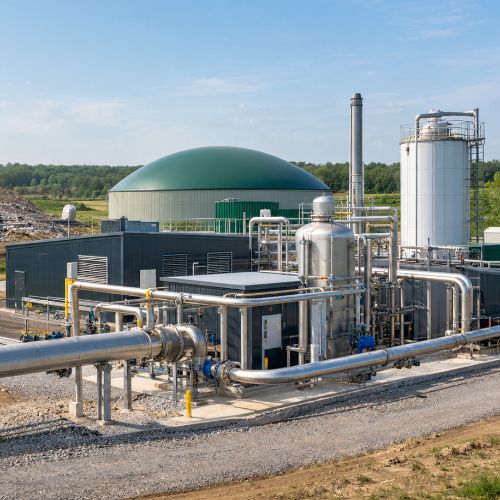
Waga Energy reported a 22% year-on-year increase in consolidated revenue to €33.5 million in the first half of 2026, while EBITDA turned positive at €0.5 million, as higher recurring revenue and increased renewable natural gas (RNG) production offset a sharp decline in equipment sales.
The French company, which converts landfill gas into pipeline-quality RNG using its proprietary WAGABOX® technology, produced 426 GWh (1.5 million MMBtu) of RNG in H1 2026, up 31% from a year earlier. The company said this production avoided an estimated 173,000 tonnes of CO₂-equivalent emissions.
Waga Energy’s results, published on 29 September 2026, show continued growth in its project portfolio despite softer conditions in the US RNG market and longer-than-expected commissioning timelines for some US projects.
Recurring revenue drives 22% growth
Waga Energy’s total revenue increased from €27.4 million in H1 2025 to €33.5 million in H1 2026.
The main driver was recurring revenue, which rose 27% year on year to €33.2 million. Equipment sales, by contrast, fell 78% from €1.3 million to €0.3 million.The improvement in EBITDA means H1 2026 was the company’s second consecutive half-year with positive EBITDA. Waga Energy said projects generated €13.4 million of EBITDA, an increase of €2.4 million year on year, while platform costs rose by €1.6 million to €12.9 million.
The company also reported that 97% of its Projects EBITDA was converted into Projects cash flow during the first half. In simpler terms, Waga Energy is increasingly earning money from RNG projects that are already operating rather than relying on one-off equipment sales.
At the same time, the company is spending heavily to build its future project portfolio. That explains why EBITDA was positive while the overall net result remained negative at €12.4 million.
RNG production reaches 426 GWh
Waga Energy produced 426 GWh of RNG during H1 2026, 31% more than in the same period of 2025.
The company currently operates 38 RNG production units across France, Spain, Canada and the United States, with installed capacity of approximately 2.1 TWh per year. Another 21 units are under construction across the United States, Spain, Italy, France, Canada and Brazil, adding approximately 2.3 TWh per year.
Together, the 59 projects represent a planned capacity of 4.4 TWh per year and estimated signed annual recurring revenue of approximately €264 million.
Waga Energy reported an average availability of 94% for units that had been operating for more than 12 months.
The company’s current project database also shows a broad international operating footprint built around landfill-gas-to-RNG facilities.
Brazil enters Waga Energy’s project portfolio
Waga Energy signed five new contracts during 2026, including its first project in Brazil.
The Brazilian project involves a 3,000 standard cubic feet per minute (scfm) WAGABOX® unit, adding Brazil to the company’s growing list of markets where landfill gas is being converted into RNG.
The 21 projects currently under construction represent additional capacity of around 2.3 TWh per year, although Waga Energy said commissioning schedules for US facilities remain longer than originally expected because of local permitting and grid or pipeline interconnection requirements.
Commercial pipeline expands to 240 projects
Waga Energy’s broader commercial pipeline has grown to 240 projects, representing potential capacity of 19.4 TWh per year, or 66.2 million MMBtu annually.
That represents a 16% increase from a year earlier and a 3% increase compared with the company’s April 2026 update. Most of the potential capacity remains at the feasibility-study stage. Phase 3 projects, which are closer to contract signing, account for 2.6 TWh per year.
US RNG market becomes more competitive
Waga Energy said the US RNG market has become more competitive, with pressure on prices and changes in commercial arrangements.
The company said some projects are being signed with shorter contract durations or offtake agreements closer to the commissioning date.
An offtake agreement is essentially a contract establishing who will buy the RNG produced by a project. Such agreements can be important for securing project financing because they provide greater visibility over future revenue.
Waga Energy said its proprietary technology remains competitive in this environment.
The company has also signed 19 US projects eligible for investment tax credits (ITCs), representing 2.3 TWh per year of installed capacity. However, Waga Energy said the longer commissioning timelines mean it may not be possible to monetise the ITCs for all 19 projects before 30 June 2028.
The company also said US projects signed since summer 2026 are unlikely to have their ITCs monetised before that date.
€210m liquidity before additional July financing
Waga Energy had total liquidity of €210 million as of 30 June 2026.
This comprised:
- €46 million in cash and cash equivalents
- €164 million in available debt, subject to conditions including the signing of offtake contracts
The company subsequently signed another €136 million in financing in July, partly to refinance existing debt associated with a portfolio of approximately 20 operating WAGABOX® units.
Its gearing ratio stood at 72% at the end of June, up six percentage points year on year.
Despite the strong liquidity position, Waga Energy’s expansion remains capital intensive. The company invested €57 million in H1 2026, while free cash flow after interest was negative at €67 million.
2026 targets pushed further out
Waga Energy has revised the timing of several previously announced targets.
The company said its approximately €200 million 2026 revenue target, 4 TWh per year installed-capacity target at the end of 2026 and approximately 660,000 tonnes of CO₂-equivalent avoided emissions target are now expected to be achieved with a time shift of about 18 months, to around mid-2028.
It has also pushed back the expected timing for achieving more than €400 million in signed annual recurring revenue.
The company now expects that milestone around H2 2027, representing a delay of approximately six to 12 months from its previous end-2026 target.
Waga Energy said the revised timelines reflect a combination of geopolitical uncertainty, longer US project commissioning periods and softer US RNG offtake-market conditions.
WAGABOX® expansion remains central to strategy
Waga Energy’s business model centres on converting landfill gas into renewable natural gas that can be injected into existing gas networks.
Its WAGABOX® technology is designed to separate methane from other components of landfill gas and produce pipeline-quality biomethane. The company operates its projects through long-term arrangements with landfill owners and local authorities.
The company’s 2025 financial results had already shown a move towards profitability, with full-year EBITDA reaching €1.2 million, compared with a €2.6 million EBITDA loss in 2024.
The H1 2026 results therefore build on a shift towards positive operating earnings while the company continues investing heavily in new RNG capacity.
Read also: Waga Energy, Casella start commercial operations at US Biomethane Plant