


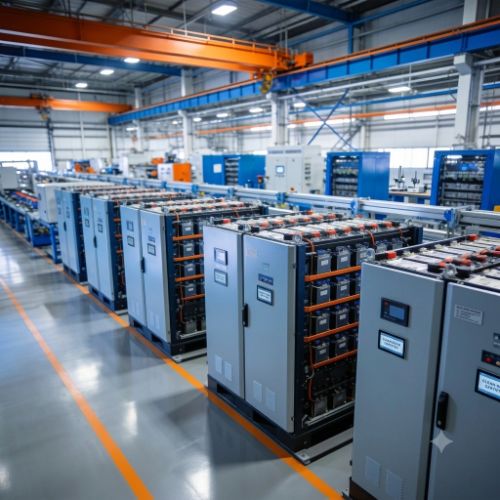
Indian solar manufacturer Sahaj Solar has approved plans to establish a battery energy storage system (BESS) factory with a planned capacity of 1.8 GWh at Dakor in Gujarat, marking its entry into battery storage manufacturing.
The company’s board approved the project on 19 October 2026. Sahaj Solar estimates that the investment will require approximately ₹25 crore (about $2.63 million), excluding the factory premises already constructed. The investment is expected to be financed through debt and internal accruals, according to the supplied source.
The company plans to add the new capacity within 12 months and launch its battery energy storage systems for domestic and international customers over the same period.
Sahaj Solar Expands Beyond Solar Manufacturing
The proposed facility represents Sahaj Solar’s first reported manufacturing capacity in the BESS segment. The company currently operates in the solar energy sector, selling solar modules, water pumps and off-grid power plants.
The planned expansion is intended to strengthen the integration of its existing solar systems business by adding battery storage to its product portfolio.
Battery energy storage systems (BESS) can store electricity for use when generation falls or demand rises. When paired with solar installations, storage can help manage variations in solar output and improve the availability of electricity, depending on system design and operating conditions.
The addition of battery storage could therefore allow Sahaj Solar to offer a broader range of energy solutions to customers seeking integrated solar and storage systems.
Sahaj Solar has estimated the investment required for the BESS factory at approximately ₹25 crore, equivalent to around $2.63 million in the supplied report. The estimate excludes the factory premises, which have already been built. The company intends to fund the investment through a combination of debt and internal accruals.
Bioenergy Business Analysis
Sahaj Solar’s proposed entry into battery storage reflects the growing convergence of solar generation and energy storage in the broader clean energy market. Although battery storage is not bioenergy, it is relevant to the wider energy transition and renewable power infrastructure covered by Bioenergy Business.
The strategic opportunity is to combine solar equipment with storage solutions. Solar modules generate electricity when sunlight is available, while battery systems can store energy for later use. Offering both technologies could help Sahaj Solar serve customers looking for more integrated renewable energy installations.
The proposed 1.8 GWh capacity is a substantial planned addition relative to the company’s reported absence of existing BESS capacity. However, manufacturing capacity alone does not establish actual output, market demand or commercial success.
For India’s renewable energy equipment sector, Sahaj Solar’s planned expansion illustrates how solar manufacturers may seek to broaden their offerings as demand for integrated generation and storage solutions develops. The project’s significance will ultimately depend on whether the company commissions the planned capacity on schedule and converts it into commercially viable sales.


