


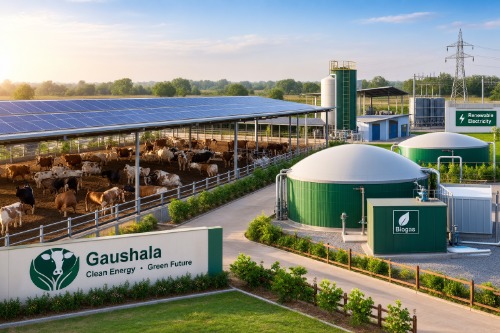
Saharanpur already has the state’s number-one self-sufficient cow shelter, which is being operated by the Municipal Corporation. Now, the Municipal Corporation has planned to build another high-tech cow shelter.
The new cow shelter will not only house stray cattle, but their cow dung and urine will also be used for various new activities.
Biogas will first be produced from cow dung at the facility, which will then be used to generate electricity. Products will also be made from cow dung that will be sent not only across India but also to foreign countries.
The objective of the cow shelter is to provide support to stray cattle roaming on the streets and to develop new innovations using cow dung and cow urine. The Municipal Corporation’s new cow shelter is expected to be better than the existing facility and could establish its identity globally. Land for the project has already been identified, and the facility will be developed at an estimated cost of around ₹150 crore.
The facility is expected to include some innovations that may not have been seen before.
Municipal veterinary officer Dr Sandeep Mishra said that the Saharanpur Municipal Corporation is currently operating the Maa Shakumbhari Kanha Upvan Gaushala, where around 565 cows are housed. The shelter is currently occupied up to its capacity.
“We are trying to build a new cow shelter by expanding this initiative. As part of this effort, we have identified land behind Mhaadi Sarovar. We are going to build a new cow shelter there. The construction department is estimating the cost for it,” he said.
According to the government’s rule, 500 cows can be housed in one cow shelter, for which ₹150 crore is provided.
Bioenergy Business Analysis
Saharanpur’s proposed ₹150 crore high-tech gaushala points to a broader shift in how cattle waste can be integrated into local bioenergy systems. Converting cow dung into biogas and subsequently generating electricity could create a productive use for a waste stream while supporting the shelter’s self-sufficiency. The proposed production of dung-based products also introduces a potential circular-economy component beyond energy generation.
The project’s scale will ultimately depend on effective feedstock collection, biogas-system design, digestate management and reliable offtake for electricity and other products. If implemented as described, the facility could demonstrate how large cattle shelters can combine animal management with waste-to-energy infrastructure and resource recovery.
Read also: India rolls out GOBARdhan guidelines with assured CBG offtake and 10-year pricing framework