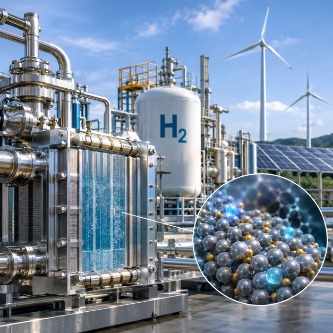
South Korean energy company SK Innovation has developed a water electrolysis catalyst designed to improve green hydrogen production efficiency and durability under fluctuating renewable electricity supply conditions, potentially supporting the production of electricity-based sustainable aviation fuel (e-SAF).
The technology, developed by SK Innovation’s Environmental Science and Technology Institute, adds a small quantity of lithium to a nickel-iron-tungsten (Ni-Fe-W) catalyst. The company announced on 18 November 2026 that the research had been published in the Royal Society of Chemistry’s Journal of Materials Chemistry A. Other developments in renewable hydrogen include Hy2gen’s 100 MW renewable hydrogen project in Denmark.
The development addresses a technical challenge facing renewable-powered electrolysers, where variations in electricity generation from sources such as solar and wind can affect catalyst performance and operational stability.
Lithium addition improves electrolyser catalyst performance
Water electrolysis uses electricity to split water into hydrogen and oxygen. When powered by renewable electricity, the process can produce green hydrogen, but intermittent power generation creates fluctuating operating conditions for electrolysis systems.
SK Innovation’s researchers addressed this challenge by introducing lithium into a nickel-iron-tungsten-based catalyst through a doping process. According to the company, the addition improves oxygen-related reaction activity within the catalyst while helping preserve its structural stability under variable power supply conditions.
The improved catalyst is intended to support more stable hydrogen production when renewable electricity availability changes. SK Innovation said the technology could help improve both hydrogen production efficiency and catalyst durability.
The company has not disclosed commercial production capacity, projected cost reductions or a deployment timeline for the catalyst.
Green hydrogen technology supports e-SAF production
The catalyst development is linked to SK Innovation’s broader efforts to advance electricity-based synthetic sustainable aviation fuel production.
e-SAF, also known as power-to-liquid sustainable aviation fuel, is produced using renewable electricity, green hydrogen and captured carbon dioxide (CO₂). Its manufacturing process involves converting CO₂ into carbon monoxide, combining it with hydrogen to produce synthesis gas (syngas), and subsequently converting the mixture into synthetic hydrocarbons that can be refined into aviation fuel.
Green hydrogen is a key input for this production pathway. Improving the efficiency and operational stability of renewable-powered electrolysis could therefore help address one of the technology and cost challenges associated with scaling up e-SAF production.
SK Innovation said it has also secured patented technologies covering several stages of the e-SAF manufacturing chain, including water electrolysis catalysts, CO₂ electrolysis, synthetic crude oil production, and e-SAF refining and conversion.
The company did not disclose the number of patents, their jurisdictions or the commercial status of the associated technologies.
SK Innovation targets wider e-SAF technology development
The latest catalyst research forms part of SK Innovation’s wider research and development activities in future low-carbon fuels.
By developing technologies across hydrogen production, carbon dioxide conversion and synthetic fuel processing, the company is seeking to establish capabilities across multiple stages of the e-SAF value chain.
However, the publication of the catalyst research and the company’s stated patent portfolio do not, by themselves, establish that a commercial e-SAF production facility is operational or that the technology has reached industrial deployment.
Further progress will depend on demonstrating performance at larger operating scales, establishing competitive production economics and securing reliable supplies of renewable electricity and captured CO₂.
Global SAF production remains below aviation industry’s 2050 requirements
The development comes as the aviation industry faces a substantial challenge in increasing sustainable aviation fuel production.
The International Air Transport Association (IATA) estimates that global SAF production will reach approximately 2.4 million tonnes in 2026, equivalent to around 0.8% of annual aviation fuel consumption.
IATA estimates that the industry will require approximately 500 million tonnes of SAF annually by 2050 to support its net-zero carbon emissions objective.
While bio-based SAF is expected to provide a significant share of future production, electricity-based synthetic fuels are also expected to contribute to meeting aviation’s longer-term fuel requirements.
For SK Innovation, improving green hydrogen production technology could support the development of this emerging e-SAF pathway.
Kim Pil-seok, head of SK Innovation’s Environmental Science and Technology Institute, said: “We will continue to leverage our research and development capabilities in catalysts, processes and synthesis to secure future eco-friendly energy technologies and contribute to building the e-SAF ecosystem.”