


Uttar Pradesh has approved the Sustainable Aviation Fuel (SAF) Manufacturing Promotion Policy 2026, introducing investment-linked incentives to attract aviation fuel producers, encourage the use of agricultural residues and create employment across the state’s emerging low-carbon fuels sector.
The policy classifies eligible manufacturing projects into three investment categories and offers financial incentives, including stamp duty exemptions, interest subsidies, electricity duty relief and reimbursement of net state Goods and Services Tax (SGST). The state aims to establish Uttar Pradesh as a major sustainable aviation fuel manufacturing hub while reducing aviation-related carbon emissions and strengthening energy security.
According to The Times of India, the policy is also intended to create additional demand for agricultural residues, potentially providing farmers with new markets for crop by-products that can serve as feedstock for advanced fuel production.
UP’s SAF policy establishes three investment categories
Under the Sustainable Aviation Fuel Manufacturing Promotion Policy 2026, eligible projects are divided into Bronze, Silver and Gold categories according to the amount invested.
The classification establishes an investment-based framework for supporting SAF manufacturing projects. However, the supplied policy summary does not specify whether the categories carry different incentive rates or whether additional eligibility conditions apply.
The policy is designed to attract capital into SAF production and associated industrial infrastructure, although actual investment commitments and project commissioning timelines will depend on individual developers and subsequent implementation.
Agricultural residues identified as SAF feedstock
A central objective of the policy is to connect Uttar Pradesh’s agricultural economy with the production of sustainable aviation fuel.
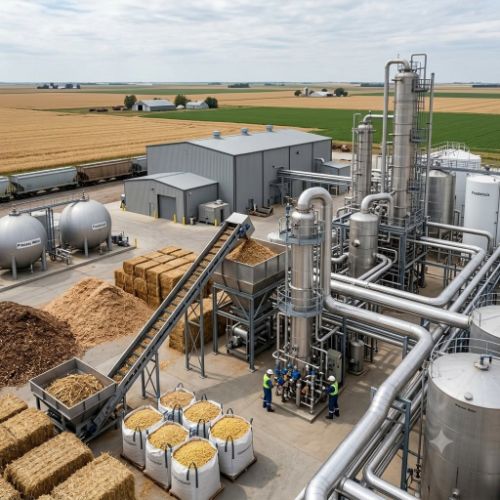
The state expects SAF manufacturing to generate additional demand for agricultural residues, including paddy straw, wheat husk and sugarcane bagasse. These materials could provide feedstock for conversion into lower-carbon aviation fuels, depending on the technology selected and the quality and availability of the biomass.
The Times of India reported that the initiative is intended to create opportunities for farmers by improving the commercial value of agricultural waste that might otherwise be underused or require management through other routes.
Potential conversion pathways mentioned in the supplied report include pyrolysis and gasification. These processes thermochemically convert biomass into intermediate products that may be further processed into fuels. Producing aviation-grade fuel requires additional conversion, upgrading and quality-control steps; the use of biomass alone does not automatically make the resulting fuel sustainable.
The commercial viability of these projects will depend on reliable feedstock collection, seasonal availability, transport costs, conversion efficiency and the lifecycle greenhouse gas emissions of the production pathway.
UPNEDA to administer policy incentives
The Uttar Pradesh New and Renewable Energy Development Agency (UPNEDA) will act as the policy’s nodal agency, responsible for approving and disbursing financial incentives.
A director-level committee under UPNEDA will evaluate applications. This administrative structure is intended to provide a framework for assessing eligible projects and managing the allocation of policy support.
The policy will remain in effect for five years from the date of its notification or until a replacement policy is notified, whichever occurs first. The effective period therefore depends on the formal notification date, which is not provided in the supplied source material.
Bioenergy Business Analysis
Uttar Pradesh’s SAF Manufacturing Promotion Policy 2026 creates a potential link between agricultural residue management, renewable fuel investment and aviation decarbonisation. Its significance will depend on whether the proposed incentives translate into bankable projects with dependable feedstock supply and commercially viable fuel production.
The availability of paddy straw, wheat husk and sugarcane bagasse offers a potential feedstock base, but developers will need to demonstrate that biomass can be collected, transported and converted at competitive costs. Competing uses for agricultural residues, seasonal supply fluctuations and the logistics of aggregating material across farming regions could affect project economics.
Technology selection will also be critical. Pyrolysis and gasification can convert biomass into intermediate products, but these processes require further upgrading to produce aviation fuel that meets applicable specifications. Investors will need to evaluate conversion efficiency, hydrogen requirements where relevant, lifecycle emissions and access to established fuel distribution infrastructure.
The policy’s investment-linked incentives could help improve project economics, particularly for capital-intensive facilities. However, the actual level of support cannot be assessed without the detailed incentive rates, eligibility conditions, subsidy limits and implementation rules.
For Uttar Pradesh, the key implementation test will be whether the policy attracts projects that progress beyond investment announcements to financing, construction and sustained production. Transparent approval procedures, reliable feedstock supply chains and clear sustainability criteria will be important to establishing a durable SAF industry.