


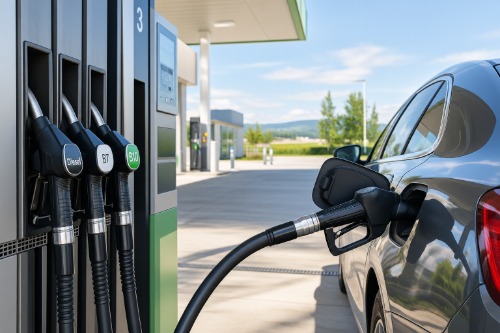
Germany’s Association of Waste-Based Fuel Manufacturers (MVaK) is calling for a faster nationwide rollout of B10 diesel, arguing that a higher biodiesel blend could reduce fossil fuel dependence while making greater use of domestic renewable fuel production.
B10 diesel contains up to 10% biodiesel, compared with the maximum 7% biodiesel content permitted under the existing B7 standard. MVaK is urging the German government to remove barriers that it says are limiting the availability and uptake of B10 at filling stations.
B10 adoption remains limited in Germany
B10 has been permitted at German filling stations since May 2024, but its availability remains constrained. MVaK has identified the requirement for stations selling B10 to also provide B7 as one of the obstacles to wider deployment.
The association is asking the Federal Environment Ministry to make this requirement more flexible. Under its proposal, Germany could maintain nationwide access to B7 without requiring every forecourt to stock both B7 and B10.
The issue is particularly relevant as Germany considers how to increase the renewable content of transport fuels while maintaining fuel availability across its retail network.
Vehicle compatibility remains a factor
MVaK said a broad range of diesel vehicles from manufacturers including Mercedes-Benz, BMW, Opel and Peugeot/Citroën are already approved for operation with B10.
Motorists can determine whether their vehicle is compatible by checking the vehicle handbook or information displayed around the fuel filler area.
However, MVaK noted that vehicles produced by the Volkswagen Group and Ford Germany have not yet received approval for B10 refuelling. This means that wider B10 deployment would still need to account for differences in vehicle compatibility across the German fleet.
European policy is pushing higher biodiesel blends
The association’s call comes against the backdrop of the European Union’s Renewable Energy Directive, or RED III, which encourages member states to increase the renewable component of diesel fuels from 7% to 10%.
Several European markets have already moved towards higher biodiesel blends. France, Belgium and Portugal have introduced B10 or higher blends, while Italy, Sweden and Ireland are preparing comparable measures, according to MVaK.
For Germany, the debate therefore extends beyond fuel formulation. It also concerns how quickly the country can align its retail fuel infrastructure with the higher renewable-fuel levels encouraged under European policy.
MVaK highlights domestic production and fuel costs
MVaK argues that increasing B10 availability could provide an additional outlet for Germany’s domestic biodiesel industry while reducing the volume of fossil diesel required.
The association also said that B10 could offer a price advantage to consumers. Based on its calculations, B10 could have been sold for up to three cents per litre less than B7 during the first half of 2026.
That estimate is an MVaK calculation rather than an independently established market result and should therefore be considered in that context.
MVaK managing director Detlef Evers said: “An increasing supply of B10 is a sensible climate, energy and economic policy measure.”
He added that the association sees the fuel as a way to reduce transport emissions, strengthen security of supply and increase domestic value creation for small and medium-sized businesses.
Bioenergy Business Analysis
Germany’s B10 debate highlights a practical issue facing renewable fuels: increasing the renewable content of a fuel is not sufficient on its own if retail infrastructure, vehicle approvals and regulatory requirements limit consumer access.
The German market already permits B10, meaning the current discussion is largely about deployment conditions rather than introducing the fuel from scratch. MVaK’s proposal to separate the obligation to maintain B7 availability from the requirement for individual stations to sell both fuels illustrates the infrastructure challenge involved in expanding higher biodiesel blends.
For biodiesel producers, wider B10 availability could create additional domestic demand for renewable fuel, while policymakers must balance fuel choice, vehicle compatibility and retail coverage. The experience of other European countries adopting higher blends also provides a policy context for Germany as it considers how to implement the renewable-fuel objectives associated with RED III.
The immediate issue is therefore whether Germany can expand B10 access without compromising reliable B7 availability for vehicles that are not approved for the higher blend.
Germany’s next step will depend on how the Federal Environment Ministry responds to the industry association’s call for greater flexibility in forecourt requirements.
Read also: EIA maintains 2026-2027 forecasts for US renewable diesel and biodiesel production