


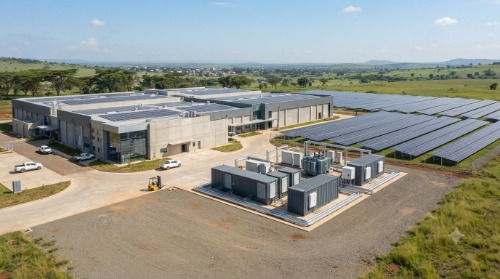
Kenyan engineering and EPC company Spenomatic is expanding its industrial renewable-energy portfolio across East Africa, combining solar photovoltaic systems, battery storage and biomass-based process-heat solutions as manufacturers seek greater control over electricity costs and power reliability.
The company’s published portfolio includes a 17.2 MWp solar installation serving steel manufacturing facilities in Kisumu and Mombasa, alongside a reported 53.22 MWh battery-energy-storage portfolio and more than 2,000 industrial boilers installed across Africa.
The expansion comes as industrial companies across the region increasingly examine captive generation and storage to manage electricity costs, production interruptions and exposure to grid constraints.
Spenomatic targets energy-intensive industrial users
Spenomatic, established in 1998 and headquartered in Nairobi, provides engineering, procurement and construction services across industrial energy, water and environmental infrastructure.
Its current portfolio spans commercial and industrial solar PV, battery energy storage, electrical infrastructure, industrial boilers and biomass systems. The company says it operates across multiple African markets, including Kenya, Uganda, Tanzania, Zambia and Nigeria.
Its solar portfolio includes installations serving steel, tea processing, rubber and footwear, food processing, milling, engineering, timber and other manufacturing operations.
The strategy reflects the particular electricity requirements of industrial facilities, where power demand can be substantial and interruptions can affect production schedules and equipment utilisation.
17.2 MWp steel manufacturing project combines solar with industrial demand
One of Spenomatic’s largest publicly documented industrial solar projects is a 17.2 MWp installation for steel manufacturing facilities in Kisumu and Mombasa.
According to the company’s project information, the systems are designed to provide on-site renewable electricity for energy-intensive steel production and reduce dependence on grid electricity.
Spenomatic also reports 53.22 MWh of battery storage capacity across its portfolio. The company says its battery systems can be integrated with solar PV, grid connections and other power infrastructure to provide peak-demand management, backup and greater operational flexibility.
The combination is particularly relevant for factories whose electricity demand extends beyond daylight solar-generation hours. Battery systems can store surplus solar generation and subsequently discharge electricity according to the facility’s load profile.
Kenya’s renewable grid does not eliminate reliability concerns
Kenya already has a high share of renewable electricity in its installed generation capacity.
The Energy and Petroleum Regulatory Authority (EPRA) reported that renewable sources accounted for 80.48% of Kenya’s total installed electricity capacity as of June 2025, including 300.5 MW of captive solar capacity. Solar represented 514.1 MW of total installed capacity, while geothermal accounted for 943.7 MW and hydro 872.5 MW.
The high renewable share, however, does not mean industrial consumers can eliminate all concerns about electricity supply. The timing and availability of generation, transmission and distribution constraints and the consequences of outages remain relevant to energy-intensive businesses.
This creates a market for behind-the-meter systems that combine renewable generation with storage and grid management rather than relying exclusively on the central electricity system.
Battery storage becomes part of industrial energy architecture
Spenomatic’s approach extends beyond installing solar panels.
The company says its industrial energy systems can integrate solar PV, battery storage, grid infrastructure, generators, controls and energy-management systems. Its stated objective is to engineer the overall power architecture around each industrial site’s electricity requirements.
This model makes load analysis and system sizing particularly important. Solar capacity, battery duration and dispatch strategy need to reflect production schedules, electricity demand patterns and the relative cost of grid and backup power.
For industrial customers, the commercial case therefore depends on more than the headline cost of solar electricity. The value of avoided outages, reduced peak demand, lower diesel-generator use and improved energy predictability can also influence investment decisions.
Biomass provides a route to decarbonise industrial heat
Electricity is only one component of industrial energy demand.
Factories in sectors such as food processing, beverages and agro-processing can require significant quantities of steam and process heat. Spenomatic’s portfolio includes industrial steam boilers, biomass boilers and thermal systems designed to use fuels including agricultural residues, briquettes, woodchips, rice husks and bagasse.
The company’s integrated approach therefore combines renewable electricity with renewable thermal energy.
This is particularly relevant in East Africa, where agricultural and forestry residues can provide locally sourced biomass feedstocks. However, the sustainability and economics of biomass systems depend on reliable feedstock supply, transportation requirements, moisture content, competing uses and appropriate emissions controls.
Regional expansion broadens the industrial clean-energy market
Spenomatic’s current corporate information identifies operations and project activity across a number of African markets, including Kenya, Uganda, Tanzania, Zambia, Ghana, Côte d’Ivoire, Mauritius, Tunisia, Cameroon and Nigeria.
The company’s published portfolio indicates that industrial solar is being applied across diverse sectors rather than being limited to a single manufacturing segment.
Its project list includes a 2.4 MW solar installation for tea processing, a 2.2 MWp system for rubber and footwear manufacturing, a 1.5 MW installation for food manufacturing, and other industrial projects in Kenya and Uganda.
The expansion of these systems reflects a broader shift in how industrial businesses approach energy procurement: renewable generation, storage and thermal systems can increasingly be considered part of core production infrastructure rather than separate sustainability projects.
Industrial power economics will shape further deployment
The pace of industrial solar and storage deployment will ultimately depend on project economics in each market.
For manufacturers, the relevant variables include electricity tariffs, solar resource, operating hours, available roof or land area, grid reliability, battery costs, financing terms and the value of avoided diesel generation.
Spenomatic says its engineering process includes site feasibility, detailed design, equipment procurement, installation, commissioning and operations and maintenance.
That integrated approach can be important for large industrial projects, where solar generation must be matched with existing electrical infrastructure and production requirements.
Bioenergy Business Analysis
Spenomatic’s expansion illustrates how industrial decarbonisation in East Africa is increasingly becoming a multi-technology proposition. Solar PV can address daytime electricity demand, batteries can shift renewable generation and provide resilience, while biomass boilers can address process heat that cannot be replaced simply through solar electricity.
Kenya’s high renewable share also highlights an important distinction: a largely renewable national generation mix does not necessarily remove the business case for on-site energy systems. Captive solar and storage can address a different set of requirements, including customer-level reliability, load management and exposure to electricity-price volatility.
Read also: Sterling and Wilson Renewable Energy secures ₹985 crore solar and BESS orders