


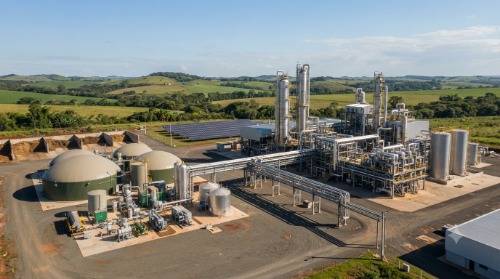
German energy company Uniper has signed a capacity reservation agreement with Syzygy Plasmonics covering future sustainable aviation fuel (SAF) production from the company’s planned NovaSAF facilities in Central and South America.
The agreement provides a commercial framework for future SAF supply produced using Syzygy’s proprietary Rigel photocatalytic reactor technology, which is designed to convert regional biogas feedstocks into low-carbon synthetic jet fuel.
The deal comes as Syzygy prepares for a final investment decision (FID) on its lead NovaSAF-1 project in Uruguay.
Uniper reserves future NovaSAF production capacity
Under the agreement, Uniper will reserve future production capacity from Syzygy’s planned NovaSAF facilities across Central and South America.
The companies said the arrangement strengthens the commercial foundation for Syzygy’s project pipeline as the developer moves towards the FID stage for NovaSAF-1.
Syzygy’s production pathway uses biogas as a regional feedstock and its Rigel photocatalytic reactor to produce synthetic fuel. The company says the technology can process distributed biogas resources while reducing the costs and operational emissions associated with conventional thermal conversion routes.
Trevor Best, CEO of Syzygy Plasmonics, said the capacity reservation demonstrates commercial traction for the company’s SAF platform as the aviation industry works to meet mandated fuel volumes.
“Uniper’s decision to reserve NovaSAF capacity reflects the commercial traction our platform is attracting at the moment when it is most needed to meet mandate volumes,” Best said.
He added that agreements of this type indicate that the market is developing in response to European Commission targets.
NovaSAF-1 advances towards final investment decision
The agreement is particularly relevant to NovaSAF-1 in Uruguay, Syzygy’s flagship project, which is approaching its FID.
The project forms part of Syzygy’s wider plan to develop SAF production facilities in Central and South America, where the company intends to use locally available biogas resources as feedstock.
The proposed pathway combines biogenic feedstocks with photocatalytic processing to produce drop-in aviation fuel. Syzygy says its technology can support fuel production that meets both biogenic and Renewable Fuels of Non-Biological Origin (RFNBO) requirements, depending on the applicable feedstock and production configuration.
This flexibility could allow the resulting fuels to serve markets operating under different sustainability and renewable-fuel frameworks.
Supply intended to support European SAF demand
For Uniper, the capacity reservation forms part of its efforts to expand its low-carbon fuels trading activities and secure supplies that can serve growing demand from airlines and other aviation fuel customers.
European aviation fuel suppliers are facing increasing requirements for sustainable aviation fuel under ReFuelEU Aviation, while international aviation is also subject to sustainability requirements under CORSIA.
The ability to access SAF produced through different qualifying pathways could therefore provide trading flexibility as compliance requirements and demand for sustainable aviation fuels expand.
Photocatalytic route targets lower-cost SAF production
Syzygy’s Rigel technology differs from conventional thermal conversion processes by using photocatalytic reforming.
The company is developing the technology to process biogas into synthesis intermediates that can subsequently be converted into synthetic fuels. Syzygy says the approach is intended to reduce both production costs and operational emissions compared with traditional thermal conversion methods.
The planned NovaSAF projects will therefore combine regional biogas availability with synthetic-fuel production, creating a pathway for converting locally sourced renewable carbon into aviation fuel.
The Uniper agreement provides commercial support as Syzygy moves NovaSAF-1 towards FID, although the project remains subject to the investment and development steps required before construction and production can proceed.