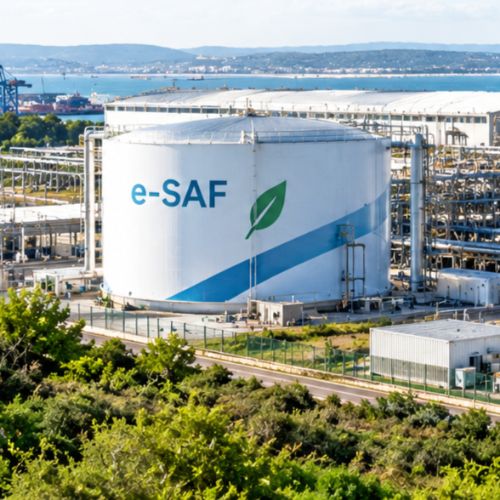
The H4 Marseille Fos sustainable aviation fuel (e-SAF) project in southern France has been invited to grant agreement preparation under the European Union’s Innovation Fund, marking a milestone for the proposed facility, which is designed to produce 75,000 tonnes of e-SAF annually from 2032.
Located in Fos-sur-Mer, France, the project aims to become one of Europe’s largest e-SAF production facilities, supporting the aviation sector’s transition towards lower-carbon fuels and compliance with the European Union’s ReFuelEU Aviation framework.
The project is led by HY2GEN, a portfolio company of Hy24, in collaboration with hydrogen industry player H2V. The European Commission’s Innovation Fund project list records H4 Marseille Fos as invited to grant agreement preparation; this is distinct from a signed grant agreement.
EU Funding Supports e-SAF Development
Selection for grant preparation represents an important step for H4 Marseille Fos as it advances plans to develop large-scale production capacity for synthetic aviation fuels.
The EU Innovation Fund supports the demonstration and deployment of innovative technologies relevant to Europe’s climate and energy transition. For emerging renewable fuel projects, such support can help advance capital-intensive developments towards implementation.
The reviewed project list does not specify an individual grant amount or final funding conditions.
H4 Marseille Fos Targets 75,000 Tonnes of e-SAF Annually
The proposed facility is designed to produce 75,000 tonnes of e-SAF per year from 2032 onwards. A July 2026 announcement from HY2GEN describes a planned low-carbon electricity supply combining renewable energy and nuclear power for the project.
Unlike conventional bio-based sustainable aviation fuel, e-SAF is generally classified as a power-to-liquid fuel because its production pathway relies on electricity-derived inputs rather than relying exclusively on biological feedstocks.
The planned facility is intended to contribute to the availability of lower-carbon aviation fuels as European airlines and fuel suppliers respond to the requirements of the ReFuelEU Aviation framework.
The project’s planned production capacity positions it within Europe’s developing synthetic aviation fuel market, where scaling production and securing reliable supplies of renewable electricity and other inputs remain important considerations.
HY2GEN Highlights European Renewable Fuels Ambitions
Cyril Dufau-Sansot, CEO of HY2GEN, welcomed the European Union’s support, describing it as a signal of the bloc’s commitment to establishing new industries with long-term energy and climate relevance.
He said the support demonstrated Europe’s intention to build the renewable fuels market required to meet its climate and energy governance objectives.
H4 Marseille Fos is a joint venture between HY2GEN and H2V; Hy24 is an investor in HY2GEN.
For related coverage, see eFuels Rotterdam’s EU Innovation Fund selection and the wider SAF production outlook through 2028. The latter covers the broader SAF market, beyond synthetic fuels alone.
Bioenergy Business Analysis
The H4 Marseille Fos selection highlights the growing role of public funding in advancing Europe’s emerging sustainable aviation fuel industry. Although e-SAF is distinct from bio-based aviation fuels, both pathways are relevant to the broader transition away from conventional fossil-derived jet fuel.
For the wider renewable fuels market, the project illustrates how policy support and investment in production infrastructure can help move alternative aviation fuels towards industrial scale.
Its longer-term significance will depend on the project’s ability to reach construction and commissioning milestones, secure competitive low-carbon electricity and other inputs, and deliver fuel at commercially viable costs.
With annual production targeted at 75,000 tonnes from 2032, H4 Marseille Fos represents a planned addition to Europe’s future e-SAF supply. Selection for grant agreement preparation is a development milestone, but does not establish a signed grant agreement, a final investment decision, a construction schedule or the start of commercial operations.