


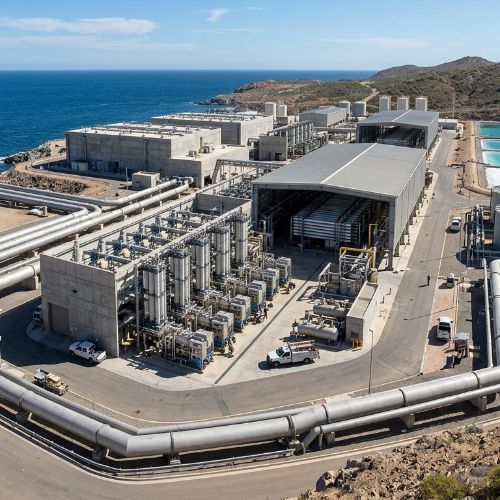
VA Tech WABAG has secured an order from Reliance Industries Limited (RIL) to develop a desalination plant and a remineralisation facility at Jamnagar, Gujarat, expanding industrial water infrastructure for one of India’s major industrial hubs.
According to Financial Express, the desalination plant will have an initial capacity of 8,400 cubic metres per hour, with the potential to expand to 12,600 cubic metres per hour, equivalent to 302 million litres per day (MLD). The project also includes a remineralisation plant with a capacity of 3,000 cubic metres per hour.
The order highlights the role of large-scale water treatment infrastructure in supporting industrial operations in water-stressed regions. Desalination can provide an alternative source of freshwater by removing dissolved salts from seawater, while remineralisation adjusts the treated water’s mineral composition to meet the requirements of its intended use.
Desalination capacity designed for future expansion
The planned facility’s initial throughput of 8,400 m³/hour is equivalent to approximately 201.6 MLD if operated continuously for 24 hours. The proposed expansion to 12,600 m³/hour would increase capacity to approximately 302.4 MLD, consistent with the company’s stated figure of 302 MLD.
The separate remineralisation facility, with a capacity of 3,000 m³/hour, is designed to treat water by adjusting its mineral content after desalination. This step can help ensure that treated water meets the relevant quality requirements for its intended application.
Financial Express reports that WABAG classified the contract as a mega order worth more than ₹1,000 crore and that the plant will use seawater and brackish water reverse osmosis. The report does not specify the construction schedule, energy requirements or expected commissioning date. These details will be important in assessing the project’s delivery timeline and operational performance.
Bioenergy Business Analysis
Jamnagar is an important industrial centre in Gujarat, making reliable water supply a significant infrastructure consideration. Large-scale desalination can diversify water sourcing for industrial facilities, particularly where freshwater availability is constrained or competing demands are high.
However, desalination also involves energy consumption and the management of concentrated brine generated during the treatment process. Project design, energy efficiency, seawater intake arrangements and environmentally appropriate brine disposal are therefore important considerations in evaluating the long-term sustainability of such facilities.
The WABAG order adds to the focus on advanced water treatment infrastructure for industrial applications. WABAG previously announced a separate effluent treatment order from Reliance at Jamnagar in September 2026. Its eventual contribution to water security will depend on the plant’s final capacity, operating performance and integration with the customer’s water supply system.
The next milestones to watch include confirmation of construction and commissioning timelines and expected operating parameters. These details would help assess how the project contributes to industrial water resilience and the wider shift towards more resource-efficient infrastructure.


