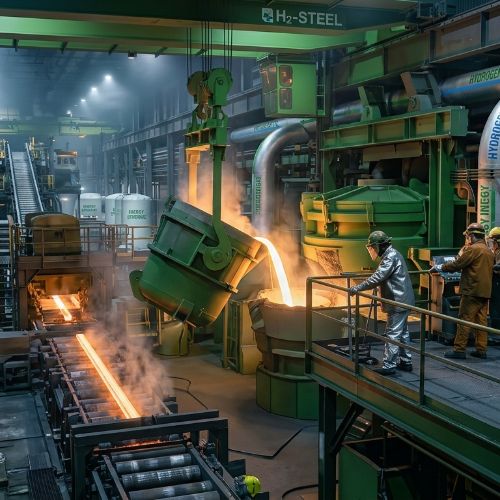
The Australian Renewable Energy Agency (ARENA) has awarded A$15 million in funding to Hadean Energy to demonstrate Australian-developed hydrogen production technology for industrial applications, including steelmaking.
The grant will support a A$30 million pilot project in Victoria, where Hadean plans to build and operate a hydrogen production plant at BOC’s Western Port Production Site. The project remains subject to final deployment arrangements and approvals.
Hydrogen produced at the pilot facility will be supplied to a neighbouring steelmaking operation to assess its potential to support lower-emissions manufacturing processes. The project is intended to demonstrate the technology under industrial conditions and advance its development towards commercial deployment.
CSIRO-developed technology aims to reduce electricity consumption
Hadean’s technology is based on solid oxide electrolysis, a process developed by Australia’s national science agency, the Commonwealth Scientific and Industrial Research Organisation (CSIRO).
The technology uses heat from industrial processes to reduce the electricity required for hydrogen production. Hadean estimates that its system could use around 30% less electricity than conventional electrolysers, potentially addressing one of the major cost barriers to wider green hydrogen adoption.
The technology has been developed over more than eight years, with previous support from ARENA. The latest funding will help Hadean progress the system towards commercial readiness while supporting Australian expertise, supply chains and advanced manufacturing capabilities.
Pilot to supply hydrogen for steel manufacturing
The proposed pilot plant is expected to produce up to 7 kilograms of hydrogen per hour. ARENA estimates that this output could supply approximately 85% of the hydrogen required for an annealing process in steel manufacturing.
The industrial trial will provide performance data to assess whether the technology can deliver more efficient hydrogen production in an operating manufacturing environment.
ARENA chief executive Darren Miller said reducing electricity consumption could help make green hydrogen more affordable for industrial users.
He said the pilot would demonstrate the technology’s performance in a real-world setting and provide evidence to assess its commercial potential, including its possible application in steelmaking and other industrial sectors.
Potential applications beyond steelmaking
While the initial demonstration will focus on steel manufacturing, the technology could have applications in other industries seeking to reduce emissions from processes that are difficult to electrify.
ARENA identified green iron and steel, as well as aviation, among the sectors where hydrogen could contribute to emissions reduction. The technology could also potentially be used to produce low-emissions synthetic fuels in the future, although the current pilot is focused on hydrogen production for steelmaking.
Bioenergy Business Analysis
The Hadean Energy project addresses a central challenge for industrial green hydrogen: the amount of electricity required to produce it. By using industrial waste heat alongside solid oxide electrolysis, the technology aims to reduce electricity consumption and improve the economics of hydrogen production.
The A$30 million pilot will be an important step in assessing whether the claimed efficiency gains can be demonstrated at an industrial site. Its planned output of up to 7 kg of hydrogen per hour is relatively small, making this a technology demonstration rather than a large-scale hydrogen supply project.
The trial could also have implications for renewable fuels if the technology is subsequently developed for synthetic fuel production. However, that remains a potential future application and is not part of the immediate steelmaking demonstration.