


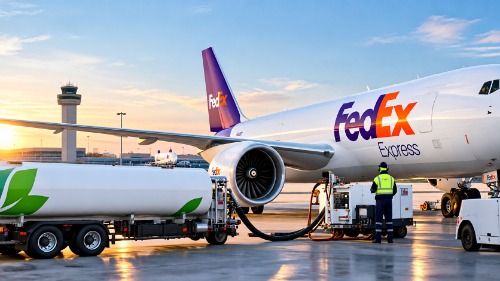
FedEx is expanding its sustainable aviation fuel (SAF) procurement across five U.S. airports, with new agreements projected to secure more than 20 million gallons of neat SAF through calendar year 2027.
The agreements cover FedEx operations at Newark Liberty International Airport, Oakland International Airport, Miami International Airport, John F. Kennedy International Airport and Dallas Fort Worth International Airport. Depending on the airport, the SAF is expected to be supplied at blend ratios of between 30% and 50%.
The latest procurement represents another step in FedEx’s effort to increase the use of lower-carbon aviation fuels across its U.S. air network. The company is targeting 30% of jet fuel blended from alternative sources by 2030.
FedEx expands SAF procurement across five airports
The new agreements build on procurement activity that began in 2025. FedEx said it secured approximately 5 million gallons of neat SAF through agreements starting that year, resulting in the deployment of 16.5 million gallons of blended SAF across the same five-airport network.
With the additional agreements, SAF blends are expected to account for a significant proportion of FedEx jet fuel consumption at the five locations, although the company did not provide a combined percentage for the network in the announcement.
Greg Paulus, vice president of Enterprise Sourcing at FedEx, said the latest agreements expand SAF use within the company’s air network and were enabled in part by incentives at both state and federal levels.
The procurement strategy also reflects the operational requirements of introducing SAF into a large aviation network, where fuel availability and airport infrastructure are important considerations alongside cost.
SAF supply and blending requirements remain central
SAF can be used as a substitute for conventional jet fuel when produced to applicable fuel standards and is generally blended with conventional aviation fuel. The blend level can vary according to the fuel pathway, applicable requirements and supply arrangements.
For FedEx, the new agreements involve blends ranging from 30% to 50%, depending on location. The company said the agreements are intended to increase the volume of SAF being used while supporting greater production and scale in the wider market.
Karen Blanks Ellis, chief sustainability officer and vice president of Environmental Affairs at FedEx, described SAF as an important component of the company’s approach to reducing emissions from aviation.
She also highlighted three factors that FedEx considers important for the development of the SAF market: reliable supply, affordability and sustainability.
The company said expanding its procurement demonstrates existing demand for SAF and is intended to support increased production.
FedEx links procurement to 2030 alternative-fuel target
FedEx’s SAF procurement forms part of its broader target to source 30% of its jet fuel blended from alternative sources by 2030.
The new agreements provide a longer-term procurement framework through 2027 across airports that form part of the company’s U.S. air network. The announcement does not specify the individual volume allocated to each airport or identify the SAF producers supplying the fuel under the new agreements.
FedEx said it will continue assessing opportunities to increase SAF use where fuel supply, infrastructure and economics are compatible with the requirements of its air operations.
That qualification is significant for large-scale aviation fuel users. Expanding SAF consumption requires more than demand commitments; airports need access to appropriate fuel infrastructure and suppliers must be able to provide consistent volumes at commercially viable prices.
Bioenergy Business Analysis
FedEx’s latest procurement demonstrates how SAF demand is increasingly being translated into multi-airport fuel agreements rather than isolated demonstration projects. The scale of the commitment—more than 20 million gallons of neat SAF projected through 2027—also provides a demand signal for SAF producers seeking to expand commercial output.
At the same time, the announcement highlights the conditions that will influence further deployment: reliable supply, affordability, sustainability, airport infrastructure and network economics. For SAF developers and investors, long-term procurement agreements can provide visibility on potential demand, while major fuel users remain dependent on sufficient production and infrastructure to integrate SAF at scale.
Read also: Finnair and Yusen logistics sign SAF Agreement for Air Cargo