


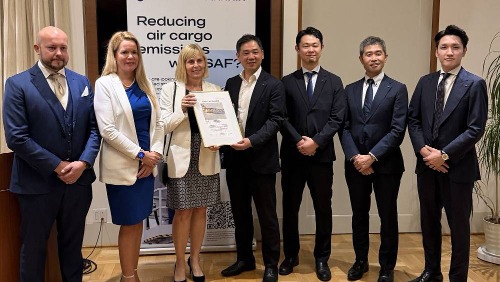
Finnair and Yusen Logistics have agreed to collaborate on the use of sustainable aviation fuel (SAF) for air cargo, with the logistics company contributing to SAF purchases aimed at reducing Scope 3 greenhouse gas emissions linked to cargo transported on Finnair-operated flights.
The agreement creates a mechanism for Yusen Logistics to support SAF use in its air freight operations while providing customers with access to related environmental attributes. It reflects growing efforts among airlines, freight forwarders and shippers to address emissions from supply-chain transportation.
SAF commitment targets air cargo emissions
Under the agreement, Yusen Logistics will contribute towards the purchase of SAF associated with Finnair’s air cargo operations. The companies said the arrangement is intended to help lower the climate impact of air freight while maintaining the connectivity and reliability required by international supply chains.
Finnair Cargo Senior Vice President Gabriela Hiitola described the multi-year commitment as an important step in developing lower-impact air cargo solutions.
“By creating long-term demand for SAF, we can help support the growth of production and availability in the years ahead.”
Hiitola also said the agreement could encourage other companies to examine how SAF can contribute to reducing emissions from air cargo.
For Yusen Logistics, the collaboration provides a way to incorporate SAF-related environmental attributes into customer sustainability programmes without requiring changes to the physical movement of cargo.
Book-and-Claim mechanism supports customer access
Yusen Logistics said its customers can access SAF-related environmental attributes through a Book-and-Claim mechanism.
Under such an arrangement, the environmental attributes associated with SAF use can be allocated to participating customers separately from the physical fuel supplied to a particular aircraft or shipment. Yusen Logistics said certificates and related reporting can provide customers with information on the environmental attributes allocated to them.
Eisuke Fukagawa, Head of Air Freight Forwarding Unit at Yusen Logistics Global Management, said customers were increasingly seeking practical approaches to address the environmental impact of their supply chains.
“Through our collaboration with Finnair, we can offer customers access to SAF-related environmental attributes through a Book-and-Claim mechanism while maintaining the service quality they require.”
The arrangement therefore links SAF procurement with corporate supply-chain emissions management, allowing Yusen Logistics to support customers’ sustainability objectives while continuing to use its existing air freight services.
SAF remains central to aviation decarbonisation
SAF is regarded as an important pathway for reducing aviation’s lifecycle greenhouse gas footprint because it can be used within existing aircraft and airport infrastructure.
Although SAF and fossil jet fuel release similar amounts of carbon dioxide during flight, the source states that SAF can have a lower carbon footprint over its lifecycle than conventional fossil jet fuel.
However, SAF production remains a small proportion of the global aviation fuel market. According to the supplied source, less than 1% of global jet fuel production in 2025 was SAF. SAF accounted for 1.6% of Finnair’s total fuel consumption during the same year.
These figures underline the gap between the industry’s growing reliance on SAF as a decarbonisation tool and its current level of deployment.
Agreement provides initial one-year commitment
The agreement between Finnair and Yusen Logistics covers an initial one-year period, with an option for continuation. The companies described the arrangement as part of their longer-term efforts to advance sustainable aviation and lower-impact air cargo operations.
The agreement was concluded with support from Western Associate Inc. (WAI), Finnair’s General Sales Agent in Japan.
The collaboration also demonstrates how SAF demand can extend beyond airlines themselves. By contributing to SAF purchases and using a Book-and-Claim mechanism, logistics providers can connect their customers with SAF environmental attributes as part of broader efforts to address supply-chain emissions.
Bioenergy Business Analysis
The Finnair-Yusen Logistics agreement highlights the growing role of commercial demand in expanding SAF adoption beyond the airline sector. Air freight customers and logistics companies face Scope 3 emissions associated with transportation, making SAF procurement and environmental-attribute mechanisms potentially relevant tools for addressing part of that footprint.
The relatively low share of SAF in global jet fuel production cited in the announcement also illustrates the scale-up challenge. Long-term or repeat commitments from airlines and freight customers can provide demand signals for SAF, but the agreement’s initial one-year term means its longer-term contribution will depend on continuation and further adoption.
For logistics providers, the Book-and-Claim approach offers a way to participate in SAF programmes without requiring individual cargo shipments to be physically transported using SAF. The effectiveness and credibility of such mechanisms will depend on transparent certification, reporting and allocation of the associated environmental attributes.
The agreement therefore represents not only a fuel procurement arrangement but also an example of how airlines and supply-chain companies are developing commercial mechanisms to bring SAF into corporate emissions-management strategies.
Read also: Port of Açu plans sustainable fuels terminal as part of 2030 Energy Transition Strategy