


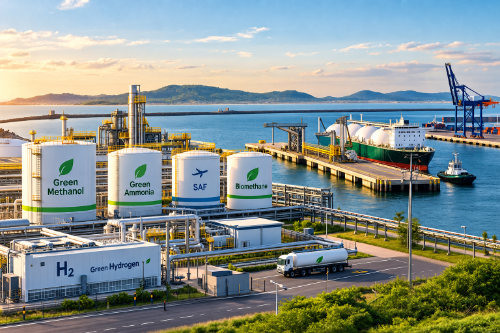
Brazil’s Port of Açu is planning a dedicated sustainable fuels terminal as it seeks to expand its role in the country’s energy transition, with green methanol, green ammonia, sustainable aviation fuel and biomethane among the fuels targeted by the development.
The project is part of the Port of Açu’s priority investment portfolio through 2030, although the planned infrastructure remains subject to environmental licensing and does not yet have a defined completion date.
Port aims to integrate fuel production and handling
Located in northern Rio de Janeiro state, the Port of Açu intends to bring multiple stages of the sustainable fuels value chain within its existing industrial complex.
According to Port of Açu CEO Eugênio Figueiredo, the strategy is to combine fuel production and cargo handling at the port. The planned terminal would support the production of green methanol, green ammonia and SAF using green hydrogen, alongside biomethane.
Açu’s existing liquids terminal is expected to play a role in the development by providing storage for the resulting fuels. The area will also be expanded to accommodate green fuel production.
The approach would give the port a role extending beyond conventional cargo handling, positioning it as an integrated location for the production, storage and movement of lower-carbon fuels.
Environmental licensing remains a key milestone
The sustainable fuels terminal is still undergoing environmental licensing, meaning the project has not yet reached a stage where a firm construction or completion schedule can be established.
Nevertheless, the development remains part of Açu’s priority investment plans through 2030. The absence of a defined completion deadline means the timing of individual structures will depend on the licensing and development process.
The planned fuel mix reflects several emerging areas of demand across the energy and transport sectors. Green ammonia and green methanol can serve as alternative fuels for maritime and industrial applications, while SAF is being developed as a lower-carbon aviation fuel.
In Brazil, the Port of Açu expects SAF demand to gain momentum from 2027, when national aviation emissions-reduction targets are scheduled to begin taking effect.
Port expands focus beyond sustainable fuels
Açu’s energy transition programme also includes changes to how the port itself consumes energy and operates its marine assets.
The complex has started testing ethanol as a lower-emission fuel alternative for smaller vessels. The initiative forms part of a broader effort to reduce emissions from port operations while evaluating technologies and fuels that could potentially be deployed more widely.
Berth electrification is another project under development. The objective is to allow ships to use electricity while docked during loading and unloading rather than keeping their engines running throughout their stay at the quay.
The port plans to initially focus on smaller vessels and equipment before potentially extending electrification to larger ships as the necessary technology and infrastructure develop.
Testing has already taken place at the terminal’s offshore berth, including trials involving tugboats, according to Figueiredo. At the port’s main berth, electrification remains under study.
The expansion into sustainable fuels is taking place alongside Açu’s established role in Brazil’s oil sector. The port currently handles about 40% of the country’s oil exports. Figueiredo also expects oil exports through the complex to increase significantly in the coming years.
A new liquids terminal is currently under construction, with completion expected in approximately 45 days. The facility will include storage areas for lubricants and marine fuels.
Vibra Energia is expected to be the first company to operate at the new terminal, according to Figueiredo.
This means Açu’s energy strategy is developing across both conventional and emerging fuels rather than replacing its existing oil-related activities with sustainable fuels in the near term.
Bioenergy Business Analysis
The Port of Açu’s planned sustainable fuels terminal reflects an infrastructure-led approach to the energy transition. Rather than focusing on a single fuel, the port is considering a portfolio spanning green hydrogen derivatives, SAF and biomethane while also examining electrification and lower-emission fuels for its own operations.
The combination of sustainable fuel production and port infrastructure could nevertheless be commercially relevant because it connects fuel manufacturing with an established logistics and cargo-handling environment. For fuel developers, the development highlights the importance of locations that can accommodate both production and downstream movement of emerging low-carbon fuels.
Açu’s plans extend beyond the proposed sustainable fuels terminal. Ethanol trials, berth electrification and continued investment in liquids infrastructure indicate that the port is pursuing several routes to reduce or manage emissions while maintaining its existing energy-sector business.
For now, the sustainable fuels terminal remains a development-stage project. Environmental licensing and subsequent investment decisions will determine how the proposed green methanol, green ammonia, SAF and biomethane activities progress towards implementation.
Read also: ClassNK SCS enters full operation as Asia’s First ICAO-Approved SAF Certification Scheme