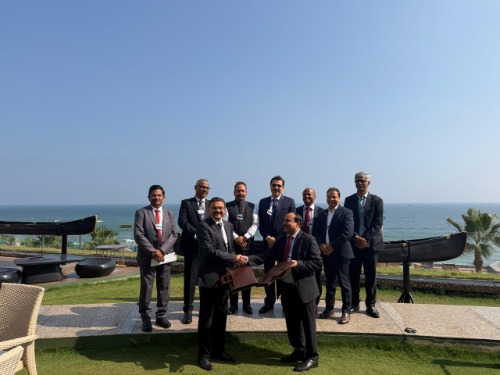
GAIL (India) Limited and Krishak Bharati Cooperative Limited (KRIBHCO) have signed a Memorandum of Understanding (MoU) to explore the development of a gas-based urea manufacturing facility with a proposed capacity of 1.27 million metric tonnes per annum (MMTPA) at Mulapeta in Andhra Pradesh’s Srikakulam district.
The agreement, signed on 12 November 2026 in Visakhapatnam, also involves the Andhra Pradesh Economic Development Board (APEDB), according to GAIL’s subsequent stock-exchange disclosure. The proposed facility would be located along GAIL’s Srikakulam–Angul Natural Gas Pipeline (SAPL), with the companies envisaging implementation through a joint venture (JV).
The development brings together GAIL’s natural gas infrastructure and KRIBHCO’s fertiliser manufacturing experience to explore additional domestic urea production capacity.
Proposed urea plant planned along GAIL’s natural gas pipeline
The proposed facility is envisaged at Mulapeta in Srikakulam district, with an annual production capacity of 1.27 MMTPA of urea.
Its proposed location alongside the Srikakulam–Angul Natural Gas Pipeline is intended to provide access to natural gas, the principal feedstock for conventional gas-based urea manufacturing.
GAIL and KRIBHCO have agreed to work together towards implementing the project through a joint venture structure. However, the MoU represents an agreement to explore the opportunity rather than confirmation that the project has reached a final investment decision.
The announcement does not specify the construction schedule, project commissioning date, investment allocation between the partners or the proposed JV ownership structure.
GAIL, KRIBHCO combine natural gas and fertiliser sector capabilities
The MoU was signed by Sanjay Agarwal, Executive Director (Business Development, Start-up and R&D) at GAIL, and C.S. Azad, Executive Director (Technical) at KRIBHCO.
The signing took place in the presence of V. Sudhakar Chowdary, Chairman of KRIBHCO; S.S. Yadav, Managing Director of KRIBHCO; and R.K. Singhal, Director (Business Development) at GAIL.
Speaking at the signing, Chowdary said the partnership would combine KRIBHCO’s experience in the fertiliser sector with GAIL’s position in the natural gas industry. He expressed confidence that the collaboration would add value to the proposed project.
Singhal described the initiative as an integration of India’s natural gas and fertiliser value chains, highlighting its potential contribution to industrial and agricultural development.
Natural gas infrastructure to support proposed fertiliser production
The proposed project links fertiliser manufacturing with GAIL’s pipeline network in Andhra Pradesh.
Natural gas is used as both a feedstock and an energy source in conventional urea manufacturing. It provides the hydrogen required for ammonia production, which is subsequently combined with carbon dioxide to manufacture urea.
Locating the proposed facility alongside the SAPL pipeline could therefore provide an important infrastructure connection for the project.
The development also reflects continued interest in expanding domestic fertiliser manufacturing capacity through partnerships between natural gas companies and fertiliser producers.
Bioenergy Business Analysis
The proposed GAIL–KRIBHCO project is primarily a natural gas and fertiliser infrastructure development rather than a bioenergy project. Its relevance to the wider energy transition discussion lies in the role of natural gas in India’s industrial and agricultural supply chains.
The proposed 1.27 MMTPA capacity would represent a substantial urea manufacturing facility if the project progresses. However, its eventual economic and operational significance will depend on project investment, gas availability, infrastructure development and the partners’ final implementation decisions.
Further information on the project’s investment requirements, gas consumption, emissions profile and implementation schedule will be necessary to assess its longer-term implications.