


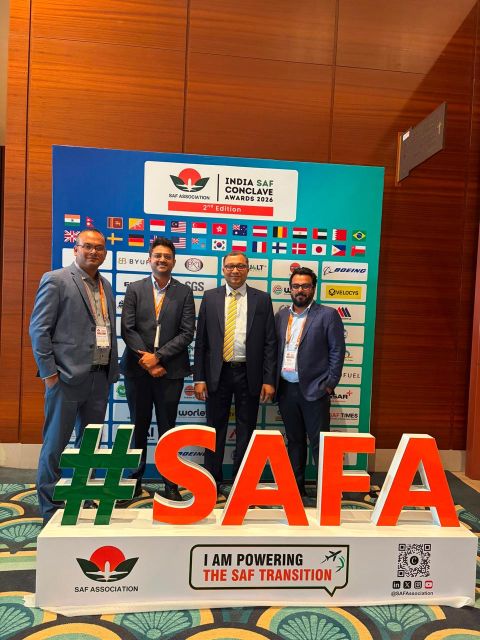
India’s sustainable aviation fuel (SAF) industry will need long-term policy certainty, improved access to capital and greater market freedom to attract investment at scale, according to Vibhav Agarwal, CEO of Essar Future Energy.
Speaking at the India SAF Conclave & Awards 2026 in New Delhi, Agarwal argued that SAF development must be assessed through the perspective of lenders and investors. For capital-intensive projects, he said, ambition alone is insufficient: developers must demonstrate that feedstock supplies, fuel demand, infrastructure and regulatory conditions can support long-term project returns.
Essar Future Energy participated in the conclave, organised by the SAF Association, and sponsored the event. Agarwal spoke during a session titled “Scaling India’s SAF Ambition: From Feedstocks and Production to Supply Chains and Demand.”
SAF projects need to meet lenders’ requirements
Agarwal said the central question for India’s SAF industry is whether projects can become sufficiently predictable and financeable to attract capital.
He identified several considerations that lenders would examine: the availability of feedstock and the ability to secure it through long-term contracts; certainty around blending requirements; long-term offtake commitments from airlines and fuel blenders; and access to airport infrastructure.
These factors connect production economics with the wider SAF value chain. Even when a production technology is commercially established, uncertainty over feedstock procurement, offtake or fuel delivery can affect a project’s ability to secure financing.
Agarwal’s argument was that SAF developers should address these risks early, rather than treating financing as a later-stage consideration.
Developers should remain open to different SAF pathways
Agarwal also called for a technology-neutral approach to SAF production, arguing that businesses should remain open to different production pathways rather than committing exclusively to one.
The pathways he identified included hydroprocessed esters and fatty acids (HEFA), ethanol-to-jet (AtJ) and power-to-liquid (PtL).
Each pathway has different feedstock, technology, infrastructure and cost requirements. HEFA uses lipid-based feedstocks such as used cooking oil and other fats and oils, while AtJ converts alcohols such as ethanol into aviation-range hydrocarbons. PtL routes use renewable electricity and other inputs to produce synthetic fuels.
A pathway-neutral approach, in Agarwal’s view, would allow developers to assess opportunities according to available resources and project economics.
Used cooking oil could contribute to India’s SAF feedstock supply
On feedstock availability, Agarwal challenged the view that India is suited to only a limited range of SAF inputs.
He pointed to annual edible-oil consumption of approximately 30–35 million tonnes and argued that used cooking oil (UCO) should not be overlooked. In his assessment, collecting even 10% of discarded cooking oil could provide a significant resource for domestic SAF production and potentially contribute to international supply.
UCO is already an established feedstock for the HEFA pathway, but its contribution depends on the volume that can be collected, verified and supplied consistently. Collection systems, traceability, competing uses and sustainability requirements will influence how much material is available for aviation fuel production.
Agarwal’s remarks place feedstock aggregation alongside production technology and financing as a central issue for India’s SAF ambitions.
Agarwal calls for longer-term policy certainty
Agarwal identified policy as the biggest gap in India’s SAF ecosystem, followed by stakeholder acceptance. He called for three changes to improve project bankability.
He called for regulatory commitments and blending mandates spanning 10–15 years, rather than periods of two to three years. Longer visibility, he argued, would give project developers and lenders greater confidence in future demand.
Agarwal proposed including SAF and biofuel projects in the harmonised master list of infrastructure projects. Such recognition, he argued, could improve access to financing for capital-intensive developments.
He also called for greater clarity on the ability of private SAF producers to sell and distribute their products. Agarwal argued that the National Policy on Biofuels, 2018, does not adequately contemplate private SAF producers operating in this way.
The policy’s published provisions cover multiple biofuel categories and feedstocks, including advanced biofuels and used cooking oil. However, Agarwal’s call concerns the specific market-access framework for SAF producers.
Making SAF investable is central to scaling production
Agarwal’s message at the conclave was that India’s SAF ambitions must be supported by the conditions required to finance and operate projects over the long term.
That means aligning feedstock supply with production capacity, securing demand through credible offtake arrangements, ensuring access to infrastructure and establishing regulatory frameworks that give investors greater visibility.
For India, these issues will shape the development of a SAF industry capable of serving both domestic aviation demand and international markets.