


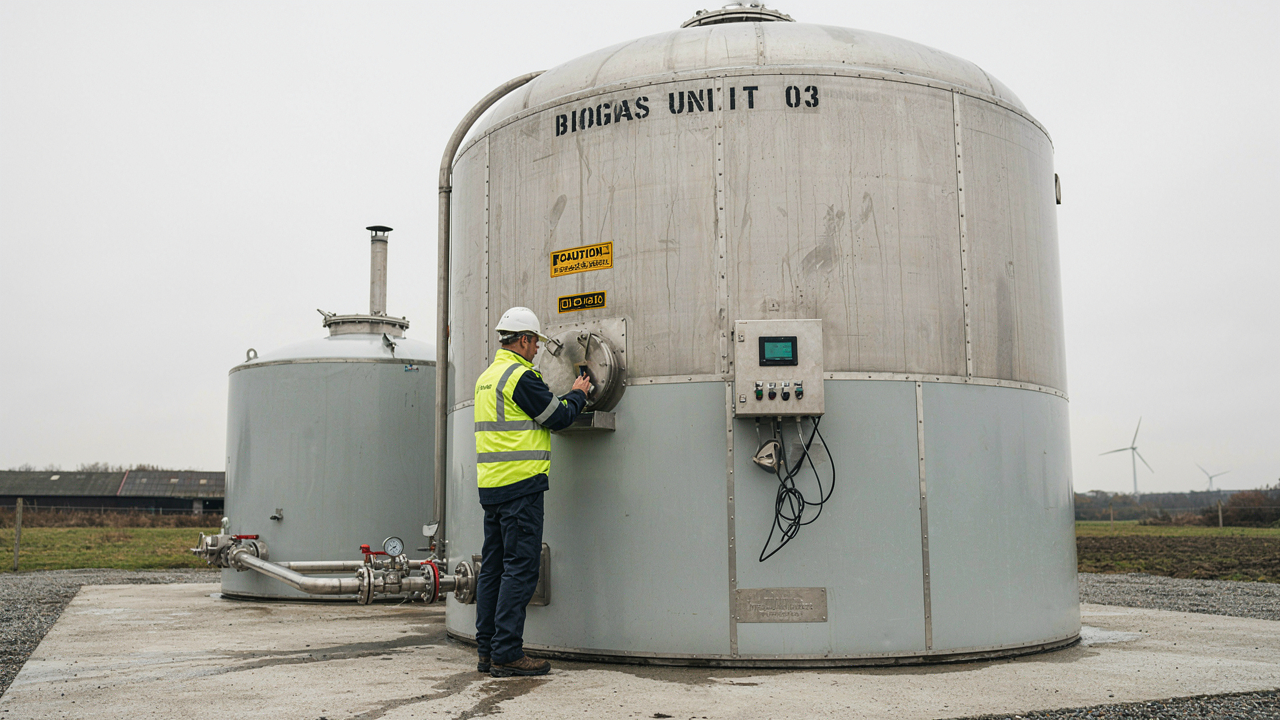
Gujarat is exploring a wider network of compressed biogas (CBG) plants through a proposed collaboration with Suzuki Motor Corporation and the Japan International Cooperation Agency (JICA), with financial and technical assistance from Japan under discussion.
The proposal was discussed at a meeting in Gandhinagar on September 23 involving Gujarat government officials and a Japanese delegation. According to the state government statement reported by The Times of India, the proposed model would establish CBG plants through cooperative dairy organisations with government support. A formal memorandum of understanding (MoU) between Gujarat, Suzuki and JICA is expected to follow, although no such agreement had been signed at the time of the meeting.
The development comes as Suzuki is already expanding dung-based biogas projects in Gujarat in partnership with the National Dairy Development Board (NDDB) and dairy cooperatives. Suzuki opened its third biogas plant in Gujarat in August and has agreed to the construction of nine plants in the state under its existing collaboration with NDDB and Banas Dairy.
Suzuki and JICA present CBG expansion proposal
The Gandhinagar meeting brought together senior Gujarat officials and representatives from Japan’s Ministry of Economy, Trade and Industry, Suzuki and JICA.
The Japanese delegation included Toyokazu Nagamune, regional representative of Japan’s Ministry of Economy, Trade and Industry; Kenichiro Toyofuku, managing officer of Suzuki Motor Corporation; Takuro Takeuchi, chief representative of JICA India; and senior representative Sota Koide.
Suzuki and JICA presented a proposal for financial and technical assistance aimed at expanding biogas infrastructure in Gujarat. The state government gave the proposal an initial positive response, according to the official statement cited by The Times of India.
The proposed framework would use cooperative dairy organisations as the platform for establishing additional CBG plants, linking the availability of cattle dung with local energy production and organic fertiliser manufacturing.
The precise number, capacity, investment value and implementation schedule of the proposed Gujarat expansion have not yet been disclosed.
Gujarat builds on existing Suzuki-NDDB dairy model
The proposed collaboration builds on an existing CBG model involving Suzuki, NDDB and Gujarat’s dairy cooperative network.
Suzuki said in August that its BANAS SUZUKI BIOGAS PLANT at Vinchhivadi in Banaskantha district was its third biogas plant in India. The facility can process up to 100 tonnes of cow dung per day and produce about 1.5 tonnes of biogas per day for CNG vehicles, alongside organic fertiliser.
Suzuki, through its Indian R&D subsidiary, agreed with NDDB and Banas Dairy in 2023 to develop biogas plants in Gujarat. The company’s latest disclosure states that the three operational plants at Agthala, Bhukhala and Vinchhivadi form part of an agreement covering nine plants in the state.
NDDB’s annual report has separately documented its collaboration with Suzuki and dairy cooperatives to develop dung-based CBG facilities, with NDDB providing technical support and Suzuki’s Indian R&D operation contributing financial and engineering expertise.
The model is designed to convert cattle dung collected through dairy networks into CBG and organic fertiliser, creating a link between livestock waste management, renewable fuel production and agricultural inputs.
Gujarat proposal aligns with India-Japan CBG initiative
The proposed Gujarat partnership also fits into a broader India-Japan programme launched in July 2026.
During the 16th India-Japan Annual Summit, the two governments launched the India-Japan Cooperative Biogas for Growth Initiative, which is intended to support India’s objective of establishing 1,000 biogas and organic fertiliser plants using the country’s dairy cooperative network. The governments also welcomed a Memorandum of Cooperation between Japan’s Ministry of Economy, Trade and Industry and India’s Ministry of Cooperation and Department of Animal Husbandry and Dairying.
Japan’s Prime Minister’s Office said the initiative would use cattle manure and other biomass resources through cooperative structures. The Japanese government has also linked the initiative to a broader objective of developing a market for CNG vehicles powered by biogas.
This provides a wider policy framework for state-level projects such as the Gujarat proposal, although the specific financial arrangements between Gujarat, Suzuki and JICA remain to be formalised.
Organic fertiliser is an important part of the model
The Gujarat proposal is not limited to gas production. The state government’s statement said the initiative would also support the expansion of organic fertiliser production alongside CBG.
That approach mirrors Suzuki’s existing Gujarat projects, where organic fertiliser is produced alongside biogas. Suzuki’s Vinchhivadi plant, for example, is designed to process cattle dung into both CBG and organic fertiliser.
For dairy cooperatives, integrating these outputs could create a more diversified project model than relying exclusively on CBG revenues. It also provides a route for returning processed biomass nutrients to agricultural land.
However, the commercial viability of individual projects will depend on factors including feedstock collection, plant utilisation, gas upgrading performance, transportation, offtake arrangements and the economics of organic fertiliser sales.
Japanese technology and financing could support scale-up
Japan’s involvement could bring together financial resources and technical expertise with Gujarat’s established dairy cooperative infrastructure.
Suzuki’s existing biogas programme in Gujarat has already demonstrated a model based on cattle dung collection, CBG production and organic fertiliser. A JICA-supported expansion could potentially extend that model beyond the existing project pipeline, subject to the terms of the proposed MoU.
Bioenergy Business Analysis
Gujarat’s proposed Suzuki-JICA partnership is significant because it moves the cooperative-dairy model beyond an individual CBG project and towards a potentially broader deployment framework. The state’s large dairy ecosystem provides an existing institutional route for collecting cattle dung, while Suzuki has already established operating experience with dung-based CBG plants in Banaskantha.
The proposal nevertheless remains at an early stage. The planned MoU has not yet been signed, and details on project numbers, investment, plant capacities, financing terms and timelines remain unavailable. The eventual scale-up will therefore depend on how the parties structure feedstock aggregation, plant ownership and operation, CBG offtake and organic fertiliser markets.
At the national level, Gujarat could become an important testing ground for the India-Japan CBG Initiative because the state already combines a strong cooperative dairy network with operating Suzuki-NDDB biogas projects. The key industry question will be whether this model can consistently achieve commercial performance at larger scale while maintaining reliable feedstock supply and viable markets for both CBG and digestate-derived fertiliser.
Read also: Suzuki Motor Corporation expands cow dung-based biogas operations in India