

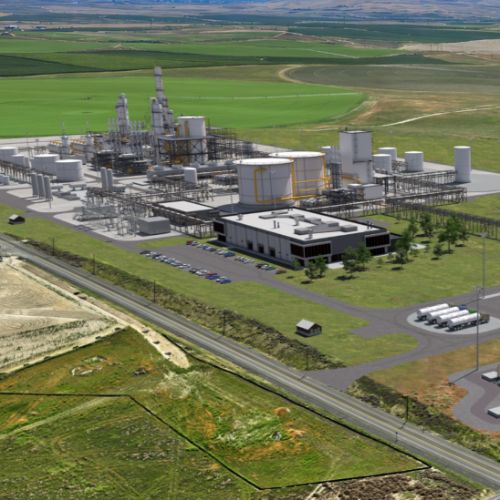
SkyNRG has selected Technip Energies, Sasol and Topsoe to support the initial engineering work for the Front-End Engineering Design (FEED) phase of Project Wigeon, a planned sustainable aviation fuel (SAF) facility at the Port of Walla Walla in Washington State, US.
The project is designed to produce 50 million gallons (143 kt) of SAF annually from renewable natural gas (RNG) using commercially established Fischer-Tropsch technology. With key permits secured and start-up targeted for 2031, the FEED phase will focus on advancing the project’s engineering design, cost estimates and execution strategy ahead of a future Final Investment Decision (FID).
Project Wigeon combines RNG with Fischer-Tropsch SAF technology
Project Wigeon will use RNG as its feedstock and combine technologies from Topsoe and Sasol to convert the renewable gas into SAF.
Topsoe and Sasol have each entered into Basic Engineering Design Package (BEDP) agreements with SkyNRG. The agreements cover technology licensing, engineering design and associated technical services for their respective technologies.
The planned process will integrate Topsoe’s SynCOR™ and hydroprocessing technologies with Sasol’s Fischer-Tropsch technology.
Fischer-Tropsch synthesis is a commercially established pathway for converting synthesis gas into liquid hydrocarbons. In the context of Project Wigeon, the technology is intended to enable the production of aviation fuel from RNG-derived synthesis gas.
Technip Energies selected for engineering and project execution
Technip Energies has been appointed to bring engineering and project-delivery expertise to the development programme. The company has experience working with both Topsoe and Sasol technologies and will also contribute its modularisation capabilities as the project moves through FEED.
The appointment extends an existing relationship between SkyNRG and Technip Energies. The companies are already working together on DSL-01, SkyNRG’s SAF production facility under construction in Delfzijl, the Netherlands.
Steve Drennan, Co-President and Project Director at SkyNRG, said the involvement of the three companies would help advance Project Wigeon towards FEED and further develop the project as a permitted, design-ready facility.
Loïc Chapuis, President of Project Delivery and Services at Technip Energies, said Project Wigeon builds on the companies’ work on the DSL-01 project and demonstrates how the company’s engineering and project-delivery capabilities can support SAF projects in different markets.
Project targets 2031 start-up
SkyNRG is targeting 2031 for Project Wigeon’s start-up. The planned annual output of 50 million gallons, equivalent to approximately 143,000 tonnes, would add new SAF production capacity to the North American market.
The project has already secured key permits, while the FEED programme is intended to establish the engineering and commercial parameters needed before an FID.
The development is being led by Andy Billig, Co-President, Commercial and External Affairs, and Steve Drennan, Co-President and Project Director.
Billig will oversee strategic partnerships and stakeholder engagement, while Drennan will be responsible for development and technical delivery. Jessie van der Linden, VP of Projects, will act as a key SkyNRG counterpart for project governance and delivery.
Boeing among Project Wigeon partners
SkyNRG is developing Project Wigeon with Technip Energies, Sasol, Topsoe and other partners, including Boeing.
The collaboration brings together technology licensors, engineering expertise and project-development capabilities as SkyNRG works to establish a commercial-scale SAF facility in the US.
The project is part of SkyNRG’s broader effort to develop SAF production capacity across different markets. Its progress will ultimately depend on completion of FEED, financing and the subsequent investment decision required to move into full project execution.
Bioenergy Business Analysis
Project Wigeon’s move into FEED represents a transition from project development towards more detailed engineering and commercial definition. The combination of RNG feedstock with Fischer-Tropsch synthesis provides a pathway for producing SAF from a non-fossil carbon source, while the involvement of established technology providers and an experienced engineering contractor is intended to reduce technology and execution uncertainties.
The 50-million-gallon-per-year scale is also significant for the North American SAF market. However, the project’s planned 2031 start-up remains dependent on the outcomes of FEED and the future FID. Key considerations will include feedstock availability and economics, capital costs, SAF market conditions, financing and the ability to execute the integrated technology configuration at commercial scale.
For the wider SAF industry, Project Wigeon provides another example of developers combining established process technologies rather than relying on an entirely new production pathway. Its eventual progress from FEED to investment and construction will therefore provide useful indications of how RNG-based Fischer-Tropsch SAF projects can be developed at commercial scale in the US.