


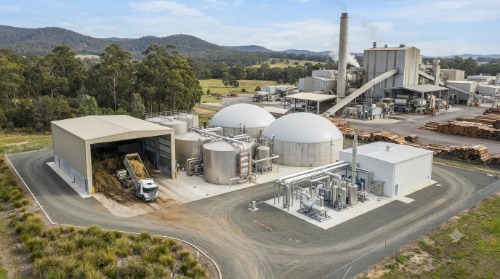
Delorean Corporation and paper and packaging manufacturer Opal have completed the concept stage of a proposed large-scale anaerobic digestion (AD) facility at Opal’s Maryvale Mill in Victoria, moving the project into a development phase that will test its engineering, feedstock, regulatory and commercial viability.
The proposed facility would convert organic residues and potentially paper manufacturing by-products into renewable biogas for use at the mill, with the primary application being the replacement of natural gas currently consumed by the rotary lime kiln. Opal says the project forms part of its efforts to identify renewable alternatives to natural gas as it works towards its decarbonisation objectives.
Delorean, an Australian-listed bioenergy developer, announced the completion of the concept stage on 23 September 2026. The project is currently estimated to require about A$35 million in construction and design investment, although that figure remains subject to further engineering and development.
Maryvale biogas project moves into development
The concept work was undertaken under the existing collaboration between Delorean and Opal and was funded by Opal.
The study examined the potential to establish an AD facility at the Maryvale site, including project design, environmental and planning assessments, feedstock discussions and commercial feasibility work.
The next development stage will provide additional information needed to determine whether the project can progress towards a final investment decision (FID).
Opal has separately confirmed that the next phase will include front-end engineering and design, regulatory approvals, securing organic feedstock and establishing residue off-take arrangements. These steps are intended to provide the basis for evaluating an FID.
The development stage is therefore a further step in the project process rather than a final construction commitment.
Biogas could replace natural gas at paper mill
The central proposition is to use organic material generated within or around the paper manufacturing operation as a feedstock for anaerobic digestion.
The resulting biogas could then be used at the Maryvale Mill to displace natural gas used by the rotary lime kiln.
This creates a potential link between waste management and industrial energy demand at the same site. Rather than producing renewable gas solely for an external market, the proposed project would have an identified industrial application within Opal’s manufacturing operations.
Opal previously said the Maryvale study was examining whether organic waste generated as a by-product of paper production could be converted into renewable biogas capable of replacing some or all of the natural gas used by the kiln.
The company has also said the renewable-gas pathway could potentially be considered at other Opal sites with significant natural-gas consumption, although any such developments would depend on further engineering and project assessments.
A$35m investment remains subject to development work
The current construction and design estimate is approximately A$35 million, but Delorean and Opal have not yet reached a final investment decision.
Further engineering will be required to establish the project’s final technical scope and capital requirements. Feedstock availability, regulatory approvals, commercial arrangements and financing will also be important to determining whether the project proceeds.
That distinction is significant because the completion of the concept stage does not represent a construction approval or committed A$35 million investment.
Delorean’s earlier project disclosures identified the Maryvale opportunity as an Opal-funded feasibility programme valued at up to A$2 million and envisaged a staged development pathway.
Potential 50:50 joint venture structure
Under the existing memorandum of understanding, Delorean and Opal may establish a 50:50 joint venture if the project progresses.
Delorean holds a first right of refusal for 50% of the equity, subject to the commercial terms ultimately agreed between the parties.
The proposed structure is consistent with Delorean’s broader Build-Own-Operate strategy. The company has been developing projects in which it retains ownership interests in bioenergy infrastructure while securing feedstock and energy offtake arrangements.
However, the potential joint venture should not be treated as a completed transaction. The final ownership structure, funding arrangements and commercial terms remain dependent on the project’s further development and FID.
Maryvale project adds to Australia’s industrial biogas opportunity
The proposed Maryvale facility reflects a broader application of anaerobic digestion in which organic residues are treated as both a waste-management stream and an energy resource.
For industrial facilities with substantial thermal-energy requirements, producing renewable gas close to the point of consumption can potentially reduce dependence on conventional natural gas while creating a use for organic residues.
Delorean’s project portfolio already includes other Australian bioenergy developments. Its South Australian Salisbury facility, for example, is being developed to process organic waste into renewable natural gas, while the company has also been progressing projects in Victoria, Queensland and other states.
For Maryvale, however, the next stage will need to demonstrate that the available feedstock, AD technology, gas utilisation system and project economics can support a commercially viable facility.
Bioenergy Business Analysis
The Maryvale proposal illustrates an increasingly important model for industrial decarbonisation: integrating waste treatment, renewable-gas production and existing industrial energy demand within a single site.
Its potential value lies partly in the alignment between the feedstock and the energy user. If sufficient organic residues can be secured on commercially workable terms, the project could create a closed-loop pathway in which material arising from industrial activity contributes to replacing fossil natural gas consumption.
The proposed 50:50 joint venture could also become important if the project reaches FID, but the ownership and investment arrangements remain subject to future agreement. More broadly, whether the Maryvale model can be replicated at other Opal sites will depend on site-specific feedstock availability, gas demand, infrastructure and project economics.
Read also: VORN Bioenergy acquires five Italian biogas plants to expand European biomethane platform